

Christoph peering through the pig. Photo by Jürgen Schmücking.
I had one of the most inspiring days of my life Monday, watching Austrian farmer/butcher Christoph Wiesner kill and dress a hog. See video below of evisceration shot by Austrian journalist Jürgen Schmücking, covering Pigstock TC and Michigan wines and beers.
We met on Marc Santucci's farm, on a warm fall day, surrounded by leaves, apple trees, and tall grass. The pigs were rooting in an open-air pen, where the slaughter took place.

Mangalitsas, aka Wooly Pigs. Photo by Jürgen Schmücking.
Christoph stunned the pig with a bolt. He explained that it was important to do this with the pig in its natural position—less stress on both animal and muscle, which can be harmed by the acidity produced by stress. He was nervous and I could see it, his own heart pounding, taking deep breaths. He petted the pig and made loving noises to it. "It's not my pig, so I don't know how it will respond," he said. "Sometimes they jump over the fence. Anything can happen."
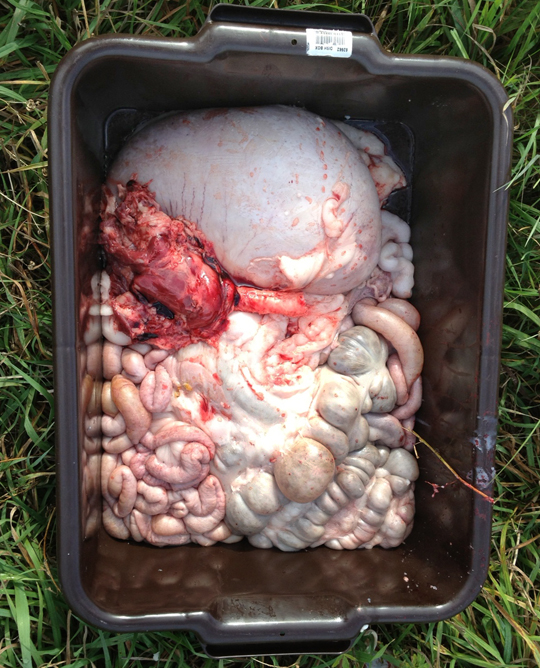
A gathering of Mangalista offall from Pigstock Traverse City 2012. Photo by Jürgen Schmücking
Once stunned, we dragged the pig onto the grass. Christoph stuck it expertly, and his wife, Isabell, held a big bowl under the pig's neck to capture the blood, about two gallons. She swished it rapidly with her hand, in the blood up to her wrist, to prevent it from coagulating. She put the bowl in a cold-water bath to chill it, swishing and spinning it continuously. Blood sausage will taste best this way, she explained.
Christoph pumped the foreleg to get all the blood out. Then he tied each hind leg to hang it. He doesn't believe in sticking hooks in legs because it damages the hind shanks.
The pig was lifted mechanically with a tractor lifter and brought to a bathtub filled with 180°F water, in which the hog was scalded, then removed to a table to have its fur scraped off. It was then relifted so that Christoph could demo the dressing, doing it slowly, showing us all the organs and viscera as they emerged, all of it to be used. When the pig had been sawn and cleaved in two, Christoph cut a strip of backfat from the pig, then cut small pieces of it for us to taste. Warm, chewy but tender, neutral in flavor, succulent. It was kind of like taking communion of the pig.
It was the most humane slaughter I've witnessed. It would be illegal by American standards, which more or less mandates inhumane slaughter.

Isabell and some Captain to drink to the soul of the pig. Photo by Jürgen Schmücking.
"I have vegetarian customers," Christoph told me. "They are vegetarian because they have seen [industrial] slaughter. But when they see how I do it, they buy meat from me."
I would, too. He and Isabell truly care about the animals. Before the slaughter, Isabell poured shots of rum for all present. "It is tradition," she called to the 30 observers. "We drink to the soul of the pig!" And she, and we, raised our glasses.
Thank you, Christoph and Isabell, for what you do. Thank you to J.T. Hoagland (head of Cherry Capital Foods and organizer of Pigstock) and all who make Pigstock happen in lovely Traverse City, Michigan, for educating more cooks and chefs.
Other links you may like:
- My recent post on How Chickens Are Processed.
- View Jürgen Schmücking's full Pigstock slideshow.
- Cherry Capital Foods is an offshoot from Earthy Delights.
- The NYT a while back wrote about the magic of the Hungarian Mangalitsa pigs.
- Here are photos from the Salumi tour in Chicago.
© 2012 Michael Ruhlman. Photo © 2012 Donna Turner Ruhlman. All rights reserved.
Great post, Michael. Thank you for sharing this wonderful butcher with us.
This reminds me of my young(er) years (1940s). A number of farmer families collectively owned a tripod made of wooden poles with a block-and-tackle pulley system attached to the top apex of said tripod.
A very large/tall cast-iron cauldron (again, shared) was set up underneath with a large quantity of water, over a fire . When the water was deemed to be hot enough, a pig was slaughtered and bled. It was then strung up, hoisted high on the pulley system, then dipped into the scalding cauldron (all through muscle power). Meanwhile, the collected blood was quickly attended to for blood sausage-making. The 'collective' tripod and cauldron would remain stored at the butchering farmer's place, until it was needed at the next farmer's.
I could go on further about the details of butchering, snout-to-tail fashion, but this is Your blog. 🙂
Respect! Great post.
Fantastic post, Michael! Thanks for sharing the experience with us.
One thing that really stirs in my mind... There is a recurrent theme in butchering like this, and many that you see, or hear about, on television such as No Reservations, or in blogs/articles online about the GOOD kind of butchering. That theme is total respect for the animal's life, and its role in our own lives. Industrialized slaughter seems so inhumane, and the animals are completely treated like just another thing, not a living being that is giving itself to us for nourishment and enjoyment. It makes me feel really good to see things like drinking to the soul of pig, and the care given to the killing process.
Again, thanks for sharing, Michael!
Great post on an important topic, humane slaughter. I knew butchers who would argue endlessly over whether it was more humane to just "stick" the hog, or stun it first. If the time between stunning and sticking was too long, a good part of the carcass could be lost (cosmetically, at least) to what is called "agonal hemorrhage", blood spots from burst capillaries in the muscles. And if the stunning was improperly done, it could result in horrible torment for the animal. Swine, in particular, are difficult to control in the moments prior to either stunning or sticking. Even seasoned professionals, like your Austrian friend, know that a slight twitch of the animal's head could have unpleasant consequences.
Having said all that, I must admit that just about all the pork I purchase comes from a more "industrialized" system.
I know that we would have had a very short working day if we passed around the schnaps after each animal was butchered.
And I hope that your 180 degrees F was a misprint in regards to the scalding water. That would burn the skin. We always tried to keep it within 150 to 155. If you had a mechanical dehairer, you could go as low as 145.
Let's hear more about this "Pigstock" and the pork products involved, please.
thx for all comments. and no, they scald for a few minutes between 170-180 F, doesn't burn skin or even cook it.
christoph stressed how important the stun was, to hold the bolt with both hands and make sure you are in the right spot, the center of a cross between ear and opposing eye. yes, agony if done wrong, part of why he was nervous.
And we drink one shot BEFORE the kill and none after!
At 180 degrees, I'm more worried about burning MY skin. But whatever works...I assume we're talking about a "captive bolt" stun gun, with a gun powder charge. Most are pistol grip. some are shaped like a coke bottle. Either way, they can be just as dangerous to the butcher as to the animal.
Stun the animal, results in less stress. Imagine how great our supermarkets would be if their butchers followed this humane practice. Keep educating Michael, thanks for sharing.
Always good to see a great examples of how animals should be respected. Thanks for the share Michael.
I enjoyed your post Michael. I also attended a "Pigstock" led by Christoph and Isabell in New Jersey three years ago. It was a marvelous experience which I highly recommend. I still have some Mangalitsa pig left in my freezer from the half I bought there. I plan to use some of it to try out techniques from your new book, "Salumi".
What a great post. Do the Santuccis butcher all their pigs the way Christophe did, or was this just for Pigstock? And more importantly, do they sell it? I'll be in Traverse at the end of November and would love to support.
I don't know, and it was actually raised by Dan Hiday at Hiday Farm in Burlington, MI. You'd have to contact Marc. But you raise a great point, even if animal is raised with care, the abattoir may be terrible. try to find out from your farmer how their animals are killed.
This slaughter was only for PigstockTC, but others are handled in the best way possible
gross
are you vegetarian?
Michael, a hog-related question...I'm making guanciale for the first time using your recipe from Charcuterie. The jowl has been in the cure for a couple of days and is pulling out a large amount of liquid, is it OK to pour this off? I'm wondering if I should maybe make up a half batch of the cure and reapply it. Thanks!
Oh yeah, and I'm taking a sausage-making continuing ed class with Chef Polycn next month at Schoolcraft. I'm so freakin' excited!
"He was nervous and I could see it, his own heart pounding, taking deep breaths."
I've dispatched thousands of animals and this is the case every time.
It's something to be taken very seriously.
“It’s not my pig, so I don’t know how it will respond,” he said. “Sometimes they jump over the fence. Anything can happen.”
So true!!! I have a bunch of stories!
"He doesn’t believe in sticking hooks in legs because it damages the hind shanks."
I totally agree with that.
As far as the scalding temp goes, 180 degrees is rather high, but maybe that's a requirement for Mangalitsas.
I've dispatched hundreds of hogs and the target temp is always 145-150 degrees....too high a temp causes problems......it can damage the skin and make the hair difficult to remove. Been there, done that!
Ruhlman, you are dressed way to nice to be trompin in hog guts. I bet you can wear a white shirt, drink espresso and eat spaghetti. I have to wear black goddamit!
I wish the video were longer. I would love to see the stun gun. All I know is " No Country For Old Men" scene and would like to see it used properley, also would like to finish Brian's sentence, while talking about colfat, I remember he said it makes a nice wrap for a terrine of pate.
One last comment;
Isabell has the primary ingredient for a fine cocktail using Cointreu, lime juice and Cpt Morgans rum, served in an iced martini glass with cinnamon sugar on the rim, or a wedge of lime. Not sure what you call it, but I had one in Vegas and it was delicious.
In Alaska we used to mix it with Dr. Pepper and lime, probably more suitable for hog slaughter, though a bit too sweet for me that way.
Heart and lung stew sounds like a recipe worth posting if you can get it.
Great post. Hope I can attend someday. But as a farm kid I must ask, what the h*ll's a "tractor lifter"?
Pretty sure he means a front bucket loader