
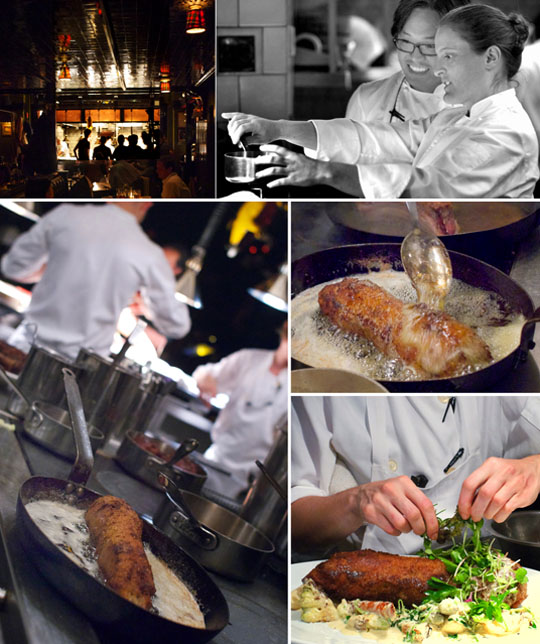
©photos by Donna Turner Ruhlman—see more at: Ruhlmanphotography.com
When Donna found herself in NYC at the Ace Hotel last fall, she spent a couple nights in the Breslin kitchen watching executive chef April Bloomfield, Breslin chef de cuisine Peter Cho, and crew rock (that's Peter and April top right). The trotter caught her eye. It's the perfect example of why this post could be called Why April Is Not the Cruelest Month But Rather the Best Porker, or simply Why We Love April. The British chef takes a great Italian classic, a zampone, as she notes, breads it, fries it in olive oil and butter, and serves it as their "Pig's Foot for 2." It's the boned out trotter, stuffed with cotechino, a pork and pig skin farce. Peter says it's currently served with braised shallots, a garlic cream sauce, and sauteed Brussels sprouts. But that changes with the seasoning. I'd serve it with an aggressive vinaigrette, maybe a gribiche and arugula. (Donna created an Ace Hotel/Brelin series which you can see on her site.)
April has had this dish on the menu since Breslin opened.
"I'd always wanted to make cotechino," she told me. "It's my favorite kind of sausage. When I was a young line cook, I used to eat it boiled between slices of bread on my break. Then I had the trotter at Au Pied de Cochon and it blew me away. It convinced me to put this on the menu."
This is definitely a fall challenge for advanced charcutepaloozians! Thanks, April and Peter for the recipe and Peter for your great iPhone process shots!
The Breslin Pig's Foot
- 1 Long Fore Trotter (about 2.75 lbs)
- Pork Fat
- Pork Skin
- ½ tablespoon kosher salt
- ½ tablespoon 4-Spice Mix (actually 7, but who's counting)
- ice water
- 2 quarts Chicken Stock
- 2 tablespoons Butter
- 1 ½ cups Bread crumbs
Equipment
- Boning Knife
- Meat Cleaver
- Scale
- Calculator
- Meat Grinder
- 5-quart mixer with paddle
- Cheesecloth
- Butcher's Twine
4-Spice Mix
- ½ tablespoon ground white pepper
- ½ tablespoon black pepper
- 1 small nutmeg, freshly grated
- ½ stick of cinnamon
- 10 cloves
- ¾ tablespoon ground all-spice
- 1 teaspoon ground ginger
- Combine all the above spices and pulverize in a spice grinder.
Butchering the Pig Foot:
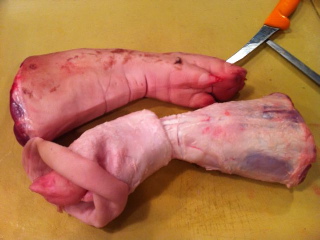
- Using a sharp boning knife, carefully tunnel the hock from the skin down to the first joint. Be sure not pierce the skin. You will slice the sinew away from the skin and pull the detached skin towards the foot. Like rolling down a sock.
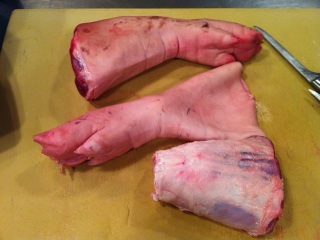
- Cut the hock from the trotter at the joint using a meat cleaver. You are removing the hock from the foot, the forearm from the wrist, as it were.
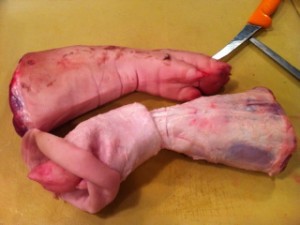
Pig's skin trimmed and peeled away from the hock
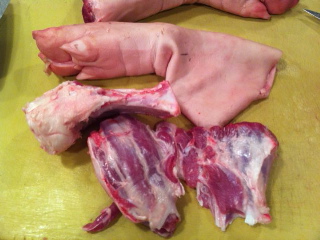
- You will need to use the meat around the hock for the cotechino farce (stuffing). Use a boning knife to remove the meat from the bone on the hock, but be sure to cut out any of the tough tendon you'll find in the hock. Discard the bone or save it for stock.
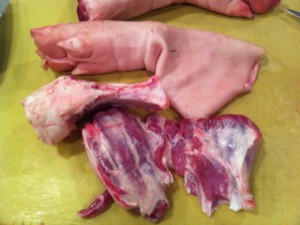
Meat removed from the hock.
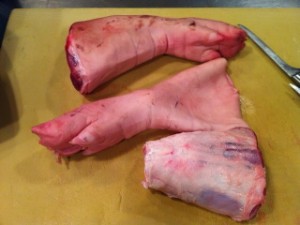
The hock removed from the foot
Making the Cotechino Farce:
- Weigh the of meat from the hock. Multiply this weight by .75; add this amount of pork skin. Multiply the weight of the meat by .25 and add this amount of fat. That is, if you have 12 ounces of meat, you would add 9 ounces of skin and 3 ounces of fat.
- This will double the total weight of the farce which will be enough to stuff the hock end of the foot. (The trotter will hold about 13 ounces/370 grams of meat).
- Cut all the meat, fat, and skin in to 1-inch/2.5 centimeter cubes. Put them in the freezer for 15-20 minutes or until they are slightly frozen.
- Combine the meat, fat, and skin and grind once through a medium die; once all the items are ground, place it back in the freezer for 15-20 minutes. Grind the meat mixture one more time through a small die.
- In a small dish add ½ tablespoon of salt and ½ tablespoon of 4-spice. Place the chilled meat mixture in the bowl of a 5-quart mixer with a paddle. Sprinkle the salt and spice mix over the meat mixture and paddle it for 1 minute on medium speed, then add a little ice water until it becomes slightly tacky and comes together.
- Cook a small amount of the farce to evaluate and adjust seasoning.
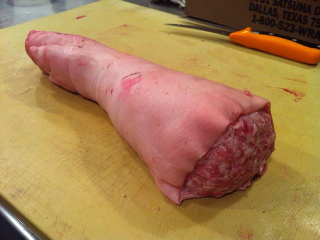
- Stuff the cotechino into the end of the foot. Once stuffed, it will take its original shape of the bone-in pig's foot.
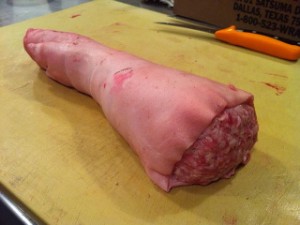
Pig's foot stuffed with cotechino
Rolling the Stuffed Pig's Foot:
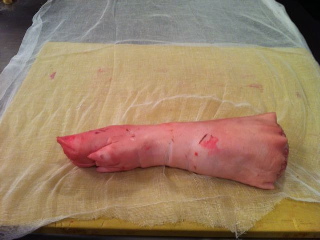
- Cut a 3-foot/90-centimeter length of cheesecloth. Place the stuffed foot at one end of the cheesecloth.
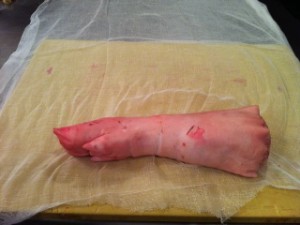
Pig's foot waiting to be rolled in cheesecloth
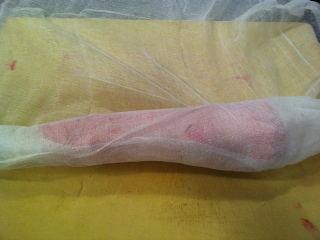
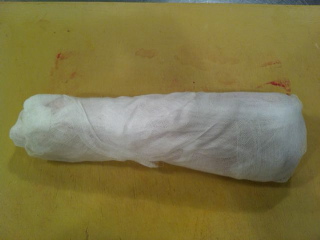
- Roll the pig's foot with the cheesecloth half way down the length of the cloth and fold the ends in so that the open end of the foot is covered completely with the cheesecloth.
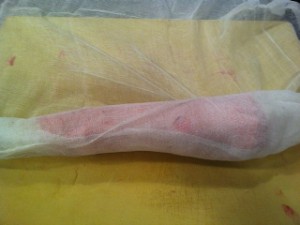
Pig's foot rolled half way
- With the ends tucked in, then roll the pig's foot the rest of the way down.
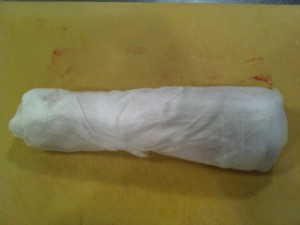
Fully wrapped stuffed pig's foot; ready for tying
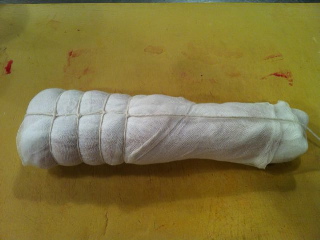
- Tie the foot, starting from the open end, with butcher's string,leaving about ½-inch to ¾-inch space between. Start at the open end so that the farce gets pushed in to the foot and not out. Tie it as you would a pork loin.
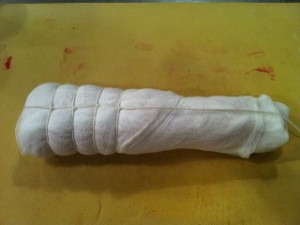
Tying the stuffed pig's foot.
- Once wrapped and tied, place the pig's foot in a pot that is large enough to hold the foot; then add enough chicken stock to cover the foot and poach for about 4-5 hours. The trotter should feel a bit floppy when you poach it. You will know it's done when you can gently squeeze the trotter and feel the bones shift near the foot end. If you can feel this, then the foot is done. The long cooking time will also make sure that the skin in the farce becomes sticky and soft and not chewy.
- Let the foot cool completely in the poaching liquid; you can even leave it in the liquid overnight in the refrigerator. The colder the trotter is, the easier it will be to work with, especially when you bread it.
- Preheat the oven to 375-400 degree F./190-200 degrees C.
- Once the foot is cool, carefully pull off all of the cloth and gently scrape off all the gelatinous liquid that is attached. (This is important, because if you leave this liquid on before you bread them, they will explode in the pan of oil as you cook them.)
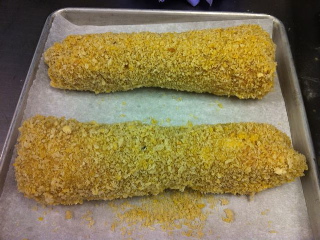
- Place the bread crumbs (Breslin uses filone for theirs, or basic pullman loaf crumbs) on a sheet tray and coat the pig's foot completely in the crumbs.
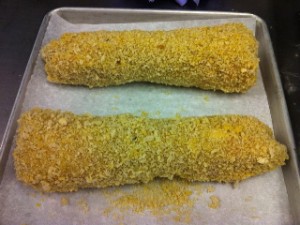
Pig's foot rolled in bread crumbs, ready to be sauteed.
- Place a large saute pan on medium heat with enough olive oil to cover the bottom of the pan to about a ½-inch thick. Once the oil is hot, add the breaded pig's foot to the pan and slowly fry off the foot turning it, so all sides lightly brown. Once all the sides are brown add about 2 tablespoons of butter to the pan and place in the oven.
- Turn and baste the pig's foot with the oil and butter until the foot is completely heated through and buttery golden brown all the way around. About 30 or 4o minutes, building the color gradually but with steady heat so it doesn't get greasy.
- Serve whole with seasonal sides dishes.
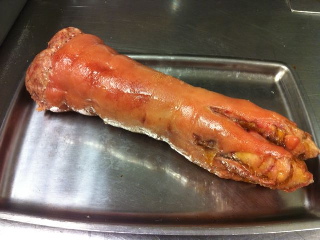
Poached pig's foot with the cheesecloth removed
Serves 2 (at least!)
If you liked this post on stuffed pig's feet, check out these other links:
- April Bloomfield, The English Chef Taking Manhattan by Storm from the Guardian UK or this New Yorker profile.
- Chichi Wang shares her recipe for Grilled Pig's Feet
- See my post on Artisan Butchers (Does Artisanal Even Mean Anything Anymore?)
© 2011 Michael Ruhlman. Photo © 2011 Donna Turner-Ruhlman. All rights reserved.
Wow, this looks amazing. My family bought a pig on the hoof a couple of months ago and processed, butchered, and cured it ourselves. I wanted to keep the trotters, but my husband and I couldn't figure out how to clean them. They were not the beautiful looking, cleaned trotters in your photos. After struggling with them for what felt like hours, we gave up and threw them out. Any thoughts on resources for how to do this?
By the way, my copy of Charcuterie was invaluable. It has about 30 bookmarks in it and everything we made (bacon, sausages, hams, guanciale) came out perfectly. Thanks for such a great book, you rock!
I keep pigs trotters in the freezer. I often use them to deepen the flavour of stocks and to add gelatin. I just throw them in frozen.
Peter says they get them fairly clean like that but sometimes use a razor to remove remaining bristles. they don't do anything to the nails.
I don't think I have the skill to do this myself, but I do have the means to get to NYC and go to the Breslin and order one.
I'll be dreaming of this until then.
Very Cool!
I'll have to give this a try come hog butcherin' time this autumn.
Meanwhile, I've got some small split trotters curing for smoked stuffed trotters for this month's challenge.
For Pieds de Cochon Farcis, I debone to the first joint.
Is there a special reason why they don't go that far?
I have a friend with pig feet, and I said I'd help her. Neither of us have been able to find information on removing the hair, and whether or not the toenails stay on. Any suggestions?
Pour hot water over the feet and remove the hairs by scraping with a knife.
The hooves stay intact.
We tried that and didn't have much luck. How hot?
145 degrees.
You can also use a blow torch to remove all excess hair. Just make sure not to char the skin to much.
Michael, I've been eyeing a recipe for Martin Picard's version of this for a long time and "pates longues" (hock + trotter) are readily available for about 3$ a pop in Ottawa's Chinatown. However I have yet to take the plunge...
My reservation stems from the deboning process; how exactly is the skin removed from the meat without any skin tearing? Little by little, like rolling off a sock? Or is the entire blade of the knife inserted longitudinally into the subcutaneous fat and then worked around the entire shank?
Thanks, Adam
a little bit of both, have to be careful.
That seems like a lot of work for a meal. Well I hope you chefs out there take notes and might consider putting it on your menus so many of us can try it.
Mr Ruhlman, how much do you pay for pig shanks ? I'd think they'd be pretty cheap . Maybe if they get real popular, they can rise in price like the wing.
Last time I checked, the wings were outrageously priced. But I guess that's because flying pigs are so rare.
funny
Grew up with pigs feet being prepared at home. Not near as elegantly as this but there is still no way to change the fact that it is a pigs foot. Sorry, as beautiful as it is, I won't be making the leap.
I wonder how it will taste with some the local cajun Andouiile? Brilliant!
I helped Ryan from http://www.nosetotailathome.com cook a very similar dish a when he was doing his 24hour cooking ( from Fergus Henderson's books ) marathon. We boned the long foot, braised it, stuffed it with a potato mix and wrapped it in caulfat and browned it off.
Was actually quite simple, but very time consuming, especially trying to tunnel bone them. oh ... and it was magnificent to eat!
http://www.nosetotailathome.com/2011/03/im-awake-and-moving-again/
the latter. you can actually cut the skin lengthways and split it open, especially if you have some meatglue or some caulfat to close it back up. We tried both ways, and tunnel boned out looked a bit better, but the taste was the same.
to tunnel bone we basically cut around the bone, rolled the skin, cut a bit more, rolled the skin etc. the joints took a bit of work to seperate and get bones out, but it wasn't too bad.
I debone as in the following video without slitting the skin or using a cleaver.....fast forward to :35
http://www.youtube.com/watch?v=9zhy56najF4
~Martin
good response thx!
That's a great post out of context.
you could try using a blow torch (the kind for making creme brulee to torch away the loose hair) or sometimes we use big tweezers (strictly for use in the kitchen only!). we're chinese so there are a variety of ways to use pigs' trotters. i love it braised in dark soy, dried chillies, chestnuts and lots of garlic...the trotters and tendons get all soft and gelatinous, great winter dish 🙂
That is funny! Not sure whether to suggest a doctor or a veterinarian.
Back to the topic: I went to a hog butchering demo recently and the butcher used a blowtorch. Don't bother with those overpriced, underpowered toys they sell in kitchen supply stores. Just go to a hardware store where you can get a good one for under thirty dollars. It's amazing how many different culinary and household tasks you can think of to use a blowtorch on.
when pigs are slaughtered they're often dunked in hot water and then scraped with special scrapers to remove bristles, remaining bristles are torched off.
That is what we did, but it was really tricky with the trotters because they are bumpy. We'll just try harder next time!
Ah, brings back memories of toiling away in Pied de Cochon's sweltering cellar, larding needles sewing up the foie gras inside their trotter sarcophagi...
I had the stuffed pied de cochon with foie gras at Picard's restaurant (http://blog.belm.com/2009/08/19/au-pied-de-cochon/); it was mind-blowing. I bought his cookbook with the intent of making the recipe at home, but the method wasn't very clear (requiring "boxing bandages" to wrap the stuffed leg before a sous vide immersion).
April's recipe clarifies all of the questionable steps. It's time to exhume the two huge pig legs from my deep freezer and get to work!
Agreed. You can put toenail polish on a pig, but it's still just pigs' feet. I'd rather smoke 'em for greens.
Agreed. Nothing better than a smoked hock to make everything taste better!
This looks lovely, especially since my source of cotechino has left the island. I do have one question - is it usual to leave the toenails on the trotters? Not something I eat often but I had wonderful pig trotters at Chez Denise in Paris and I'm sure I would have noticed the presence of toenails. And I KNOW my daughter, who was about 10 at the time, would have had something to say. Really curious.
The Bresin is great. My wife and I had brunch there with Pardus and Claudia. A very cool place.
This post almost convinced me to try this!
thanks for sharing information.....really nice post
Is there a particular temp on the oil? I know cooking time/temp combinations will vary depending on process and size, but if you can find a ballpark temp of the oil to aim for it would soothe the neurotic baker in me.
350 degrees usually a good fry temp. will try to join in on the comments later today, got unexpectedly busy yesterday!
Chef April is a true inspiration for chefs. I am a NY native and its amazing how a young woman can bring an entire concept/cuisine to the States. A TRUE gastropub is hard to find in the ATL where I am. But maybe its not fair that I compare them to Breslin. 🙂
I am curious about the poaching for 4 - 5 hours - I'd like to sous vide instead just because I have one now! How long do you think it would take and at what temperature? My husband ate pickled pigs feet growing up and I think I will surprise him with this.
140 F/60 C for 48 hours, perfect, and though i've never tried it, you probably have an 8 hour window on either end, but plan on longer rather than shorter.
http://www.google.com/imgres?imgurl=http://blog.usaseopros.com/wp-content/uploads/2009/08/homer-simpson-drooling.jpg&imgrefurl=http://blog.usaseopros.com/2009/08/13/homer-simpson-or-a-ned-flanders-marketer/&h=320&w=279&sz=31&tbnid=L5Ao9ghb45_toM:&tbnh=240&tbnw=210&prev=/search%3Fq%3Dhomer%2Bsimpson%2Bdrooling%26tbm%3Disch%26tbo%3Du&zoom=1&q=homer+simpson+drooling&usg=__0yBuFBLUIfzXf4WGZxOh1VPnBfw=&sa=X&ei=cs-fTeX6MsPdtwf7jrWTAw&ved=0CCEQ9QEwAA
I split this dish with my brother-in-law just 7 nights ago, prior to going to a show at MSG. The concept and the presentation I loved, but I must admit that the spices in the farce, specifically cinnamon (I think?) were so overwhelming at times as to make the dish a bit too Christmasy at times. All in all, I enjoyed it, and the brussels sprouts & sauce were fantastic. I would certainly be interested in one of the other seasonal preparations of the trotters.
thanks for this recipe. this reminds me of one of my favorite dining experiences ever - when i split the stuffed pigs foot with my dad up at Au Pied De Cochon up in Montreal. that seared fois gras on top was etherial
Could you slice the chilled foot into burger sized rounds? then bread and fry those?
absolutely! that's kind of how the trotter is done at bouchon.
Wow! This reminds me of my mother. She used to make something similar with pork legs. She likes to stuff all kinds of things --- milkfish, frogs, pork chops, chicken legs, crab, bitter melon, squid --- I can go on and on. She's Filipino by the way.