
I want to call attention today to Dan Barber’s New York Times opinion piece from a week and a half ago, “What Farm-to-Table Got Wrong,” and his new book The Third Plate: Field Notes on the Future of Food. Both address the “odd duality” of our country’s embrace of sustainable agriculture, local food, organic food, farmers’ markets, and the farm-to-table movement with the fact that Big Food is getting bigger.
Corn and soy account for 50% of the farmed land in this country (mainly a variety of corn that’s not edible until processed, I’m guessing).
The current agricultural situation seems untenable in the long haul. In the short term, it’s created a population so sick we currently rack up a billion dollars a day in health care costs. On the other hand, do I really want my local grocery store to shut down so that I'm forced to rely on whatever I can find locally? Not given this past winter, that's for sure.
Barber, chef of the Blue Hill restaurants in New York, tries to reimagine a meal of the future, and it would be dictated by what grows best, where, when, and how. His editorial recognizes that in order for him to have a strain of wheat that creates astonishing bread, the soil has to be replenished with rotation crops, such as buckwheat or millet or mustard greens. Therefore, when those crops are growing, that’s what we should eat, and chefs need to lead the way.
(Barber’s comments, and his NPR interview, reminded me of a meal Donna and I had at a little B&B outside Rome. We were served zucchini blossoms, then zucchini soup, followed by a zucchini pasta. Allesandra shrugged, serving the third course, and said, “It’s what’s growing now.” She had traded some firewood for a goose, which finished the meal.)
Barber also urges us to eat not what we feel like, but what the land is offering, noting that good nutrition and a healthy environment go hand in hand; the reverse seems also to be true.
Caring for the soil begins with understanding how incredibly complex it is. In another recent book, The Soil Will Save Us, journalist Kristin Ohlson likens the soil to a coral reef; it’s that alive, and also that vulnerable if we don’t appreciate it and care for it. Thousands of years of bad farming and ranching practices worldwide have led to the soil's losing 80% of its carbon, she writes, which is now in the atmosphere.
Both authors try to imagine ways toward a better future. With famine in some parts of the globe, industrial agriculture abundance in others, and speckles of hope in the United States (whether it be home cooks preserving food and raising backyard chickens to the farm Barber describes that truly understands good farming practices), it’s an incredibly complex picture with no easily attainable solutions. But at least the conversation is underway and continuous.
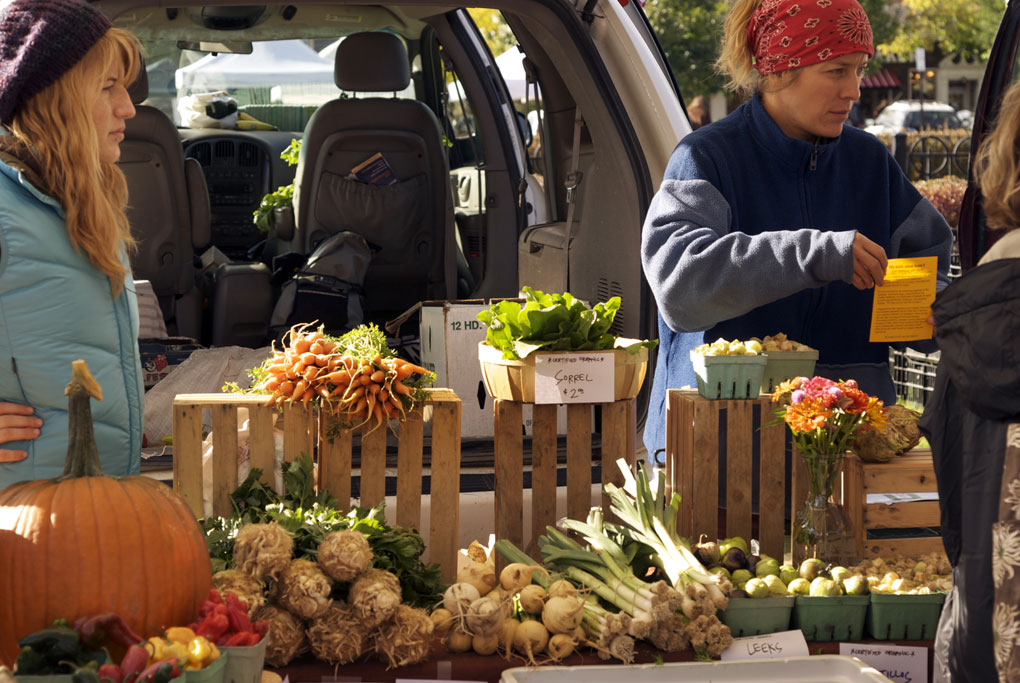
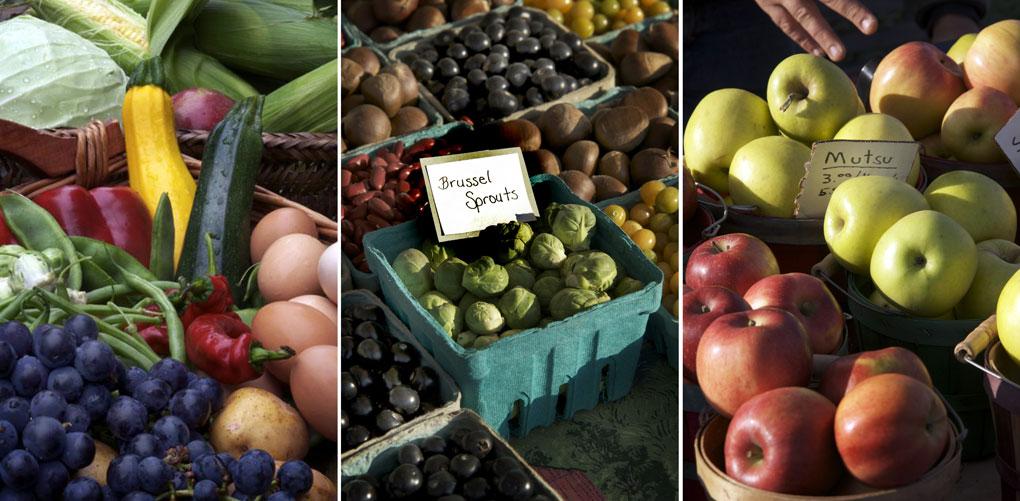
(I'll be interviewing Dan in Cleveland at the Museum of Contemporary Art, Tuesday, June 10; I'll have a lot of questions. Photos by Donna at our North Union Farmer's Market.)
Other links you may like:
- My past post on Farm Transparency v. Farm Secrecy.
- Mark Bittman’s opinion article 11 Trillion Reasons to eat your vegetables.
- Family Farm Defenders is a nonprofit organization supporting our family famers.
- Civil Eats keeps up to date with all the politics in the American food system.
© 2014 Michael Ruhlman. Photo © 2014 Donna Turner Ruhlman. All rights reserved.
Great article. "Barber also urges us to eat not what we feel like, but what the land is offering, noting that good nutrition and a healthy environment go hand in hand; the reverse seems also to be true.".....with so many greenhouses and hydroponic plantings of fruit and vegetables how do we know what is coming from the land (because now we get to enjoy year round veggies and fruits).. or does it matter for our health?
Your best bet is Majority V. Mostly vegetables, little bit of humanely-raised meat to spice things up. Very little gluten. A little splurge now and then. 10 percent sugar, tops.
As a 3rd generation farmer raising generation #4 with ONLY farming to support our family, I have yet to find a solution within reach - and believe me, we in the industry think about this a lot. My son will probably not be able to make a living at farming even if he is gifted the land and an 85 year old business. The regulations alone are killing small farmers. I can only imagine what he'll be up against in 10 or 15 years.
We encourage our customers in NY's Hudson Valley to buy farm shares and get to know their local farmers. A CSA is a great way to experience locally grown foods in season. For example, our winter CSA offered a minimum of a dozen different items every week through February. This is without any hydroponic production, simply storage crops and cool-weather greenhouse greens (no peppers, zucchini or tomatoes).
It wouldn't be impossible to dive into a strictly local diet overnight, but given a full season to 'put up' veggies and fruits, one could be quite content with a huge variety of locally sourced nutritious foods. Freeze things like corn, beans, broccoli, peppers... make tomato sauce... make jam or applesauce or IQF berries.
I think we as a culture are so accustomed to instant gratification that we won't accept anything less than exactly what we want when we want it. Nothing will change agriculturally and politically speaking (because ag, both big and small, is ruled by politics) until WE change. I hope to see it in my lifetime.
Great to hear from a farmer, thanks for commenting.
What great commentary about a problem that affects us all, even those of us who merely enjoy the bounty farmers produce. I am hoping that we, as a nation, will grow to value good, fresh food that is grown without all of the chemicals used by big ag. Here's to a better future where your son and all the other farmers will begin to make a difference in our lives.
Michael Ruhlman, please delete this post as it has nothing to do with your articles while also presenting a possible risk to those who choose (foolishly) to click on the link. Thanks.
thanks, am having terrible spam issues. thousands seem to get caught but a few slip through.
Hey Congratulations on the NYTimes article...it was a delicious read..http://www.nytimes.com/2014/05/30/dining/a-tasting-expedition-with-michael-ruhlman.html?partner=rss&emc=rss
It really is an 'instant gratification' mentality when it comes to customers. Im a chef in Sacramento, CA. I have just about anything you can think of to work with but it is never what customers want. Chicken, beef, salmon & fast food are the normalcy. I feel like a lot of America is like that. Hyper local is great but not necessarily sustainable. Teaching people to cook and food/nutritional education is really the key to turning big ag on its head.
I'm so glad you featured this subject. I feel almost vindicated, at last! I've complained over the years that something is different about the fruits and vegetables I've eaten over the course of my life. I grew up in Maryland with fresh produce almost exclusively in the summer only and have lived in CA with abundant produce year round, for the past 40 years and I taste a difference in fresh produce. I've been told it's my aging/jaded taste buds or that I'm not expert enough to state my opinion about what I think is the flavor difference between then and now. I've always said it's the soil and climate. There is an earthiness that has been missing in the flavor of most produce I've eaten out here. A certain "something" that has to do with conditions of growing. I was so happy to have abundant produce year round when I moved to CA, but it tasted different, like it was missing that loamy acid soil that I was used to seeing in summer, the humidity that kept the whole plant moist as it grew and the dormant winter that let the soil rest. I just reasoned that it had to be those conditions that produced a superior product. Everyone here thinks I'm imagining it, but I swear, to me, it's different and this soil thing makes total sense to me.