
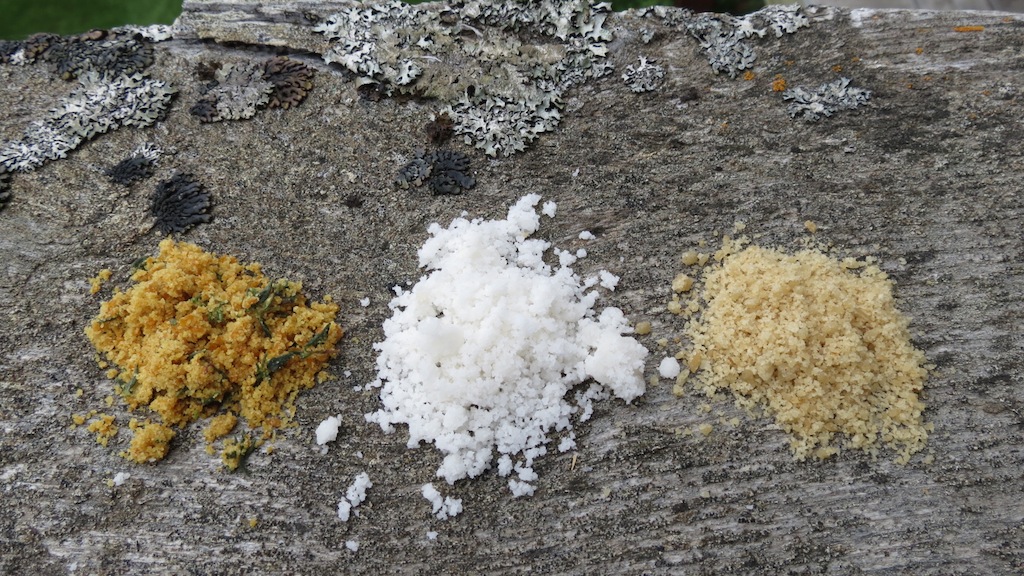
3 salts that are self harvested. Photo by Carri Thurman.
I'm thrilled to publish this guest post from Carri Thurman, baker and chef at Two Sisters Bakery in Homer, Alaska, on one of life's vital substances, salt. Without it, we die. A kitchen without it is incomplete. A cook who uses it carelessly will flounder. And the cook who, curious and surrounded by salt in solution, decides she wants to try to bring it forth herself? —M.R.
The Alchemy: Salt from Water
by Carri Thurman
“My mother boils seawater. It sits all afternoon simmering on the stovetop, almost two gallons in a big soup pot. The windows steam up and the house smells like a storm. In the evening, a crust of salt is all that’s left at the bottom of the pot. My mother scrapes it out with a spoon. We each lick a fingertip and dip them in the salt and it’s softer than you’d think, less like sand and more like snow. We lay our fingertips on our tongues, right in the middle. It tastes like salt but like something else, too—wide, and dark. It tastes like drowning, or like falling asleep on the shore and only waking up when the tide has come up to your feet and you wonder if you’d gone on sleeping, would you have sunk?”
That arrived in an email today from my daughter who had no idea I was working on this post. It is an excerpt from an essay on water for one of her classes. Now nineteen and a college sophomore, she has been witness to more of my food experiments than she can count. This is one that worked beautifully. I boiled a lot of seawater this summer. Mostly because while those of you down south were sweltering in one of the hottest summers ever, we were freezing our butts off here in Alaska. Anchorage experienced its coldest summer since they started keeping track of those things and in Homer, 220 miles south, we suffered through more 40-degree mornings than not. With all the cold and rain that accompanied, it just seemed right having cauldrons of hot water warming up my kitchen. And, I like to think of cooking as alchemy and while we may not call it art, I believe that there are certain mystical forces at play here—to be able to take a pot of water from the ocean and with very little effort extract from it something that will in turn transform whatever it touches. The beauty of salt is its ability to anonymously elevate everything it contacts. And to be able to conjure this valuable resource from something so vast to me is magic.
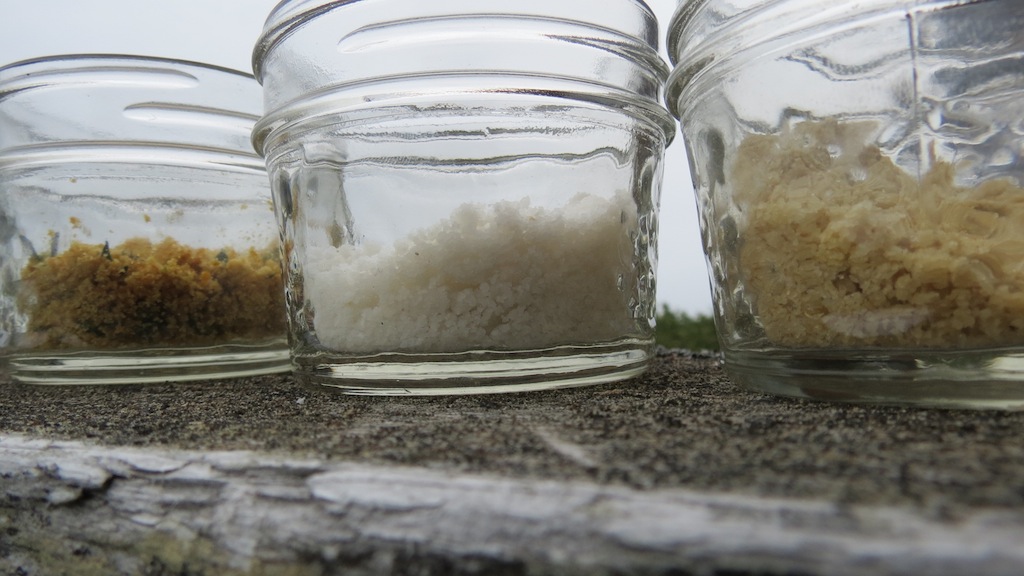
My friend Maurice is a writer who loves to cook, and I am a cook who loves writing, so whenever we get together the ideas fly. This summer, at his family’s camp across the bay for their yearly 4th of July celebration, much of the conversation revolved around making salt from seawater. We wondered if salts from other parts of the bay would taste different and discussed methods of declumping. From there the experiments continued until I think we have come up with the easiest, best method. Now that I have made the switch in my career from baker to savory chef running the dinner scene here at the bakery, salt and its many abilities rule my world and make it possible to use local ingredients as fully as they deserve.
To make your own salt from seawater:
For me it all starts here.
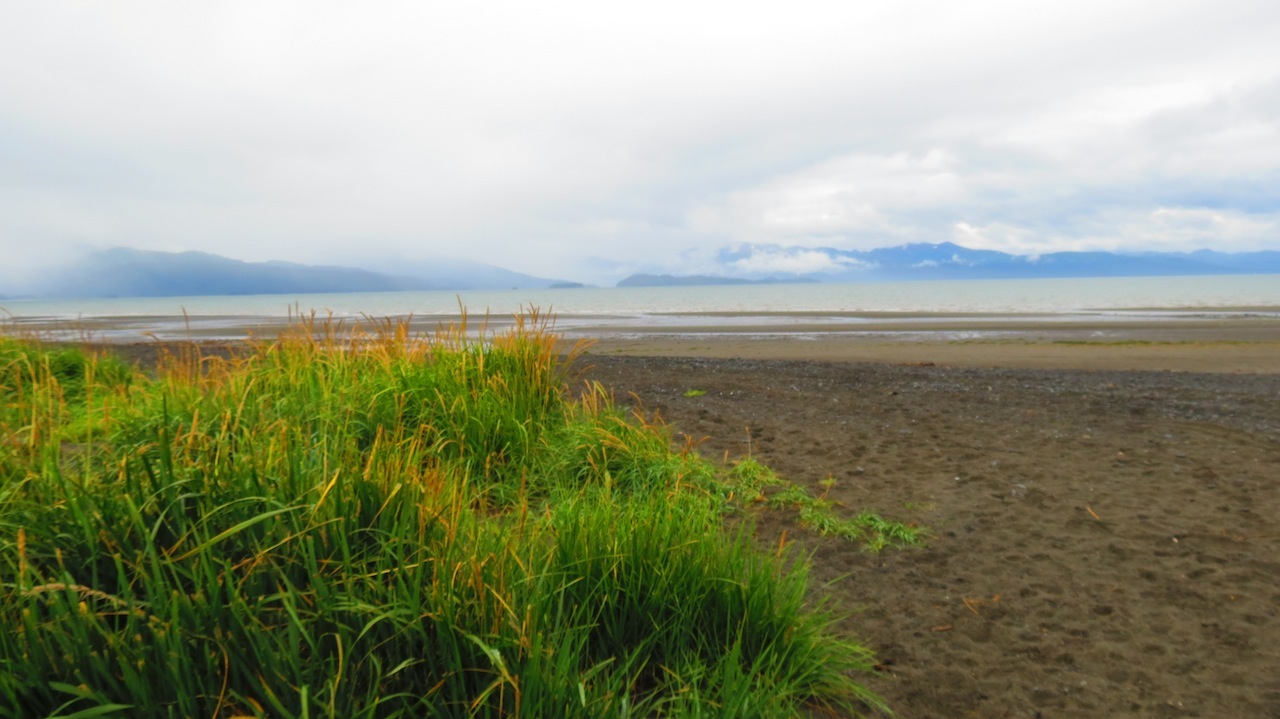
It all starts out at the beach.
It is important to be sure your collection site is away from any possible human pollutants. Don’t collect on rainy or stormy days when things are stirred up. I gathered my water at slack tide right from the beach of Kachemak Bay. Homer has some crazy tidal changes, so it’s important to keep a tide book handy.
1. A gallon of water will produce about a cup of salt, depending on the salinity of the water in your area or recent heavy rainfall.
2. Filter your water through a fine cloth (Ruhlman’s All-Strain kitchen cloths would be perfect for this) into a glass or ceramic pot. I used stainless the first time and it worked great, but then in my research for this post I found that the stainless might react to the salt at high heat. Until I get that documented, I figure better safe than sorry. Do not under any circumstances use aluminum.
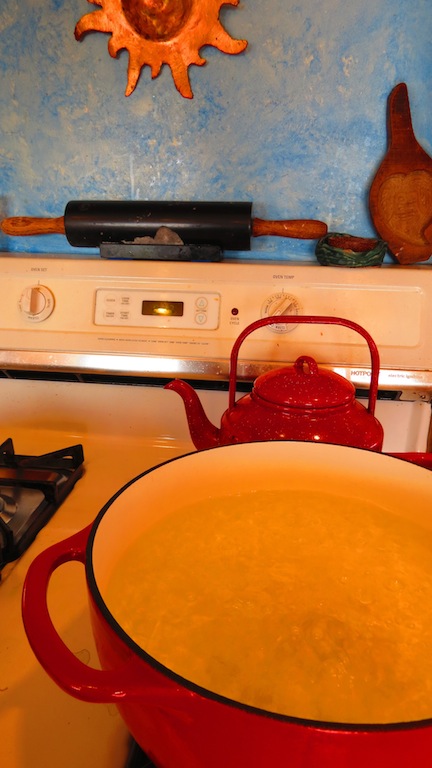
Bringing the salted water to a hard simmer.
3. Once it is in the pot, bring to a hard simmer and let it go for about 2 hours per gallon of water. Yes, the house will start to smell like the sea, but that’s part of the magic.
4. As the water evaporates, stir occasionally and at the point it becomes a wet sludge, pull it off the heat and pour into a shallow glass pan.
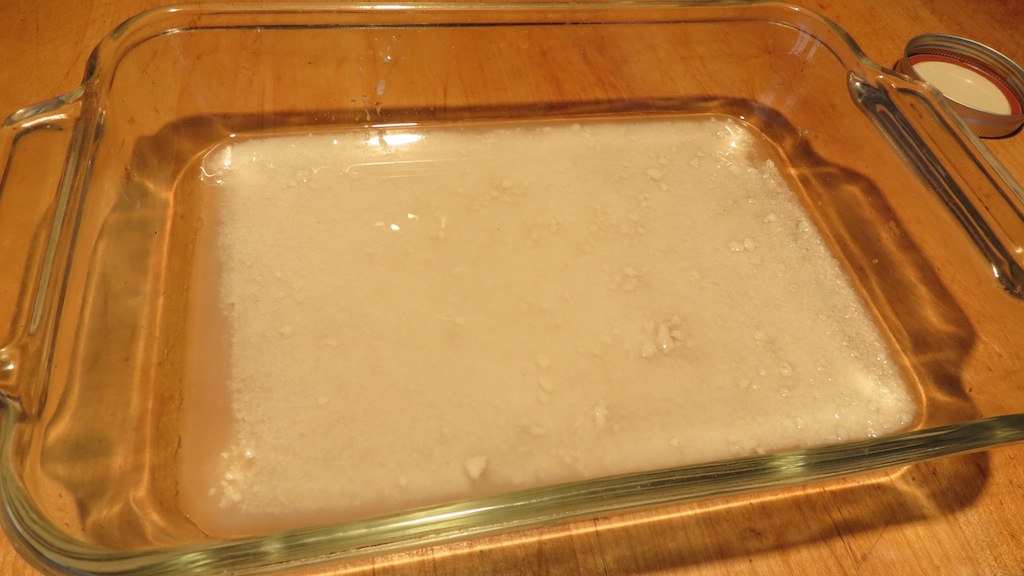
Pour the simmered water into a shallow pan.
5. Spread the mixture out and dry further by either putting in the sun in a drafty window for a day or baking in a 200°F oven for another 30 minutes.
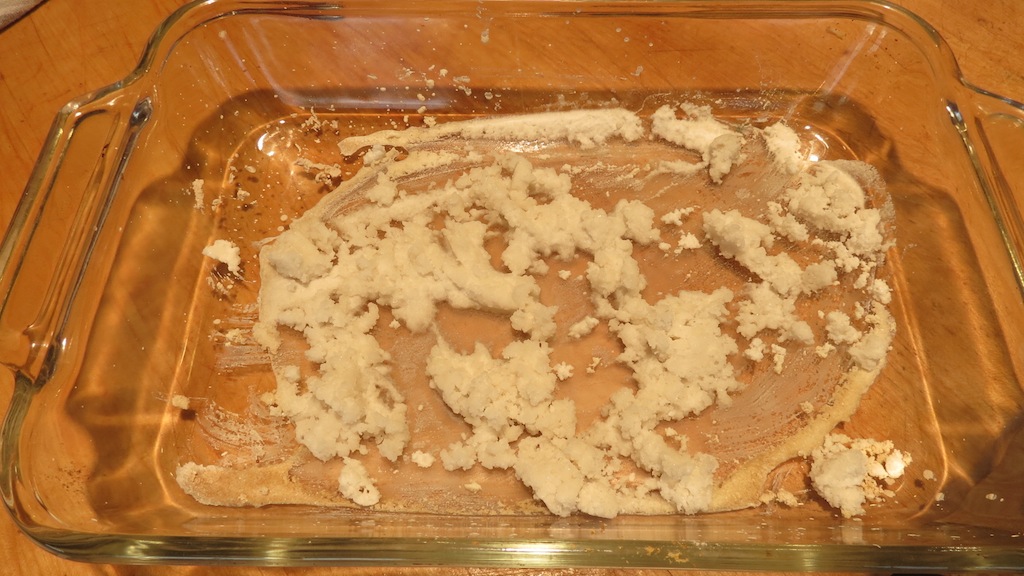
Dried salt.
6. Scrape together and break it up with your fingers if you like big chunks or with a mortar and pestle to make it finer. You can also press it through a tamis or sieve.
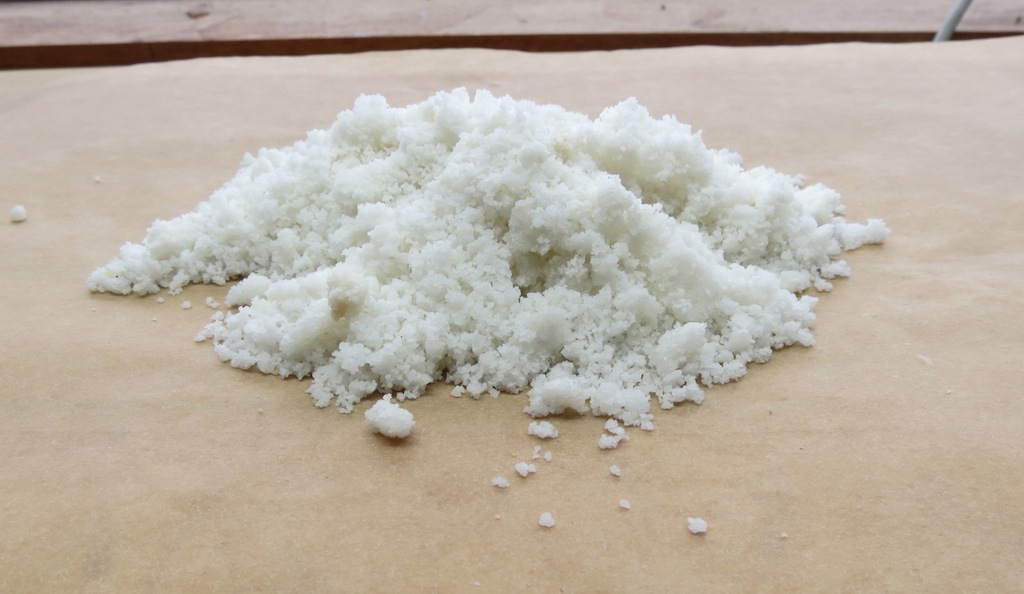
To make flavored salt I added garlic cloves to the water and pulled them out as the sludge was forming . . . it’s got a nice caramel color and amazing roasted garlic flavor. I made the orange thyme salt by zesting orange rind into the saltwater and then grinding fresh thyme into it once it was dry. I rubbed it on pork ribs. Yeah.
If you don’t want to use fuel to dry your saltwater you can fill a shallow glass baking pan and leave it undisturbed in a sunny airy window. I unfortunately did not have enough heat or sun or patience to do this. I did use my oven for other things while I was baking the salt to not waste all that heat.
How does it taste? As she said, like the sea, wide and dark.
Other links you may like:
- My post on The Potassium Effect: Important Ratio and Salt Sense.
- Salty Seattle shares I Make You Salt, You Like Me.
- Buy salts from Mark Bitterman at the Meadow.
- My popular salt posts: veal salt, lemon confit, and home-cured bacon.
- Harold McGee discuses the colors, shape, and texture of salts in the NYT.
© 2012 Michael Ruhlman. Photo © 2012 Donna Turner-Ruhlman. All rights reserved.
Now that's mighty cool. All I need now is an ocean... 🙂
Any worries about pollution? You would kill off any creatures for sure.
I wondered if you could filter it and then extract the salt? Will have to try!
What is the title of that essay? I would love to read more.
Me too, her teacher has the rest!
Brilliant, and being that I live on Cape Cod I can't wait to try this. Also thinking of cooking it out on the gas grill so the house doesn't smell like the sea 🙂
Funny because my main motivation for doing this is to make my house smell like the sea!
So you're going to burn $40 worth of propane to make a cup of salt? Why not just go to the store, spend $10 on a container of high-quality French sea salt and call it a day?
Linda Miller-Nicholson (aka Salty Seattle) did a great post on making salt, http://www.saltyseattle.com/2010/11/i-make-you-salt-you-like-me/
Love it! Thanks for posting. Just need to find myself closer to virginal waters. Astoria NY just ain't cutting it.
How bad do you want it? Try my suggestion to Marty a few comments down!
This is lovely. I live mid-continent, but I think the next time I visit my best friend on the coast I must do this (cook it down to the wet-sludge stage in her kitchen for compact travel, I think, and finish the job at home so I get some of that lovely sea smell in my own kitchen).
I just put up a half-gallon of preserved lemons that I started in February, and now I have several cups of amazing moist, scented salt left over. In the next few days I'll be drying it out and making a citrus grilling rub.
Imagine if you lived somewhere that lemons grew by the sea and preserved them in the salt from there....how amazing would that be?
come to new zealand, lemons in our garden, sea down the road...
I think you've got the yield wrong, Carri. Seawater is about 3.5% NaCl, so it would take two gallons (256 ounces) to yield a cup (8 ounces) of salt.
All I know is when I boiled a gallon of water the salt I got out of it measured just about 1 cup. Doesn't salinity vary depending on where you are?
Salinity doesn't vary that much in the ocean (there is a lot of mixing keeping the salinity pretty constant). What's happening is that you probably measuring by volume and Ronald is calculating by weight. Your daughter writes that the salt seems more like snow and this leads me to believe that its a pretty open crystal structure resulting in a lot of air gaps in the final product. If you weigh your cup of salt I wouldn't be surprised if it came in at closer to 4 oz than 8.
Thanks, Chris...that is entirely possible!
I live near Galveston and the water is not very clear. Would it work there?
I wonder, if you let the water sit a bit to let the solids rest, then strain through a cloth and run through a Britta or something like that...let me know if you try it!
what a beautiful and elegantly-written post! i didn't "discover" salt until i was 29, and in fiji. there, i assume they use a similar method of boiling down sea water. heretofore, salt was something i almost never added, but the fijiian salt was a revelation to me, i had never tasted anything like it, so i began salting everything...including my fruit at breakfast. your words bring this flavor back to me. believe me, i will print and hang on to this post. someday, when i am not ensconced in one of these lacustrine cities of the midwest, i WILL try making salt. thank you!
My first 'salt' was Hawaiian Sea Salt. A complete revelation!
I've actually been to the Two Sister's Bakery in Homer. I live in Colorado but my sister lives near Anchorage. We stopped by the bakery when we were in Homer last summer for several days. It was awesome! I highly recommend it.
Thanks for the nice review, Nick! Judging from the crazy lines out the door this summer we are doing something right. 😉
wow, what an interesting article. Now I'm trying to think of a place in my country where I could find water that it's appropriate (and by that I mean non polluted or at least as possible).
This post immediately reminded me of a childhood memory of going to the beach and collecting a couple of buckets of sand, on Mom's orders. She used the sand to dry roast peanuts, and salt them at the same time. I must have been only 4 at the time, but it's a clear memory. I also remember thinking that she was one smart lady to utilize something that was readily available and FREE.
I love this. That is exactly what I'm talking about...it's using something that's, like, everywhere!
Ron and Carrie,
The answer to Ron's question is hidden in the text of Carrie's daughter's e-mail - the salt is "less like sand and more like snow". Density! Exactly why when you bake you should use weights, but when you "cook" - you season to taste (Michael - chime in here.) I believe that commercially produced salts are done so over long periods of time using energy in the form of evaporation from the sun. The chrystals that form are more dense and therefore heavier by volume. To test this Carrie, you may try some "slush" in your 200 degree oven and some on the lowest settling of a dehydrator. If your interested... Wonderful post - I may have to try this myself!
Thank You, Kevin...And to Ron for pointing out my error. Truly, I was measuring by volume, not weight. I should know better by now, especially posting here. Michael is so gracious as to not boot me for my transgressions! (weight will be affected by how much moisture is still in the salt also)
So, it's important that the water is sourced far away from human pollutants. How far is far enough? Do you need to find a source that's more or less civilization free? Are the waters of beaches rated "A" by groups like healthebay good enough to use, or are public beaches near cities an absolute "don't"?
That is just so totally cool, and yet another reason to live where you can source your own ingredients.
Making salt from the sea sounds fun. If only there was a sea in the mid-west.
I have tried putting salt in the smoke after the meat is done. It worked OK. Wetting the salt first might help draw in the smoke better.
Put the salt, spread out in a shallow dish in from the very beginning...it takes way longer than you might think. I use almost exclusively alder wood with maybe some wild pin cherry so other woods may work faster but think many hours not a couple of.
Something about salt, eh?
I'm lucky or smart enough to live on the east coast of Vancouver Island and have been doing evaporated salt for a few years now.
Simply harvest the water off the end of a boat ramp at flood tide, wade in up to your chest and carry it home in those white buckets everyone has a few of and pour it into a child's wading pool (shaped like a turtle!) in the back yard's sunniest and breeziest spot.
It's poured through cheese cloth in multiple layers to filter out bits and chunks of flotsam and jetsam and the pool is covered in cheesecloth, loosely, to keep debris out.
The rest the sun and wind does.
It is marvelous finishing salt, way more than we would ever use so it's gifts of jars of salt for everyone and they are highly anticipated.
Really gets the hunter~gatherer part of my reptile brain engaged, you know?
Thank you Carri for a fantastic post.
I've always wondered if it was possible to make your own salt at home from seawater, you have shed light on a new method of producing great local flavors. I am a big fan of rosemary lemon zest salt, and veal salt. I take them with me whenever I travel. Local salt will even be better!
I’m clearly late to this post, but I just moved to Baffin Bay in south Texas. It’s one of the saltiest areas of the gulf due to being *nearly* land locked and very shallow. It gets HOT in the summer, so I’m thinking some large black glazed disks will yield enough for the family and possibly the fishing lodge I manage.
I can’t help but wonder at the above comment re: fuel usage who recommended purchasing salt all the way from France... how much jet fuel did that take? (And you even mentioned that you were preparing other things at the time). I think I could even do it on the wood stove here for our chillier evenings and wake up to a nicely humidified house and fresh salt for my eggs.... the possibilities are endless.