
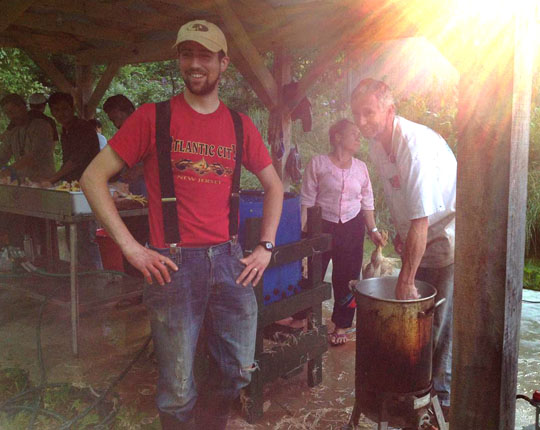
Bradley Cramer processing chickens he raised at Schmidt Family Farms in Medina, Ohio. His dad, behind him scalding birds, helps./All photos are by me and my iPhone.
What follows is an example of the best of all possible processed foods.
In an effort to be better connected with the food I eat, I visited the Schmidt Family Farms in Medina, Ohio. It’s managed by Susan Schmidt, whose specialty is honey. She gave me some of her good stuff and it’s the best honey I’ve ever tasted. By far. Tastes like the actual wildflowers around her home.
Susan’s farm is organic. She gives Bradley Cramer, who works in a music store in Medina, a small part of it to raise chickens on during the summer. ("People don't realize that chicken is a seasonal food," he told me.) He keeps them in large hoop cages that he wheels around the pasture every day so they have fresh bugs and stuff to eat. He tried letting them run outside the cage but too many were getting eaten by hawks.
The following video, which I shot with my iPhone, shows the process of taking a chicken from feathers to cookable. The photos below the video show each part of the process, including the killing and bleeding (so don’t scroll down if you’re squeamish). What was special about the day I visited (with Vivian Goodman, a reporter for WKSU, an NPR affiliate) was that Bradley was training Burmese refugees who have been relocated to this part of Ohio. They’re hoping to become farmers themselves. This is how small-scale, sustainable farming can spread.
I also participated in killing and eviscerating a chicken so that I would know how it felt. It wasn’t fun, but it was deeply instructive.
The breed is called Cornish Cross. Bradley says the speed at which they grow, from hatched to dispatched in 6.5 weeks, is too fast. If he were to wait one more week, he’d be selling six-pounders rather than four-pounders (he charges $3.75 per pound, better than most Bell & Evans). They grow so fast they don’t have time to start reproducing. This is part of the American need for fast food that even Bradley is kind of hamstrung by. One thing at a time, though.
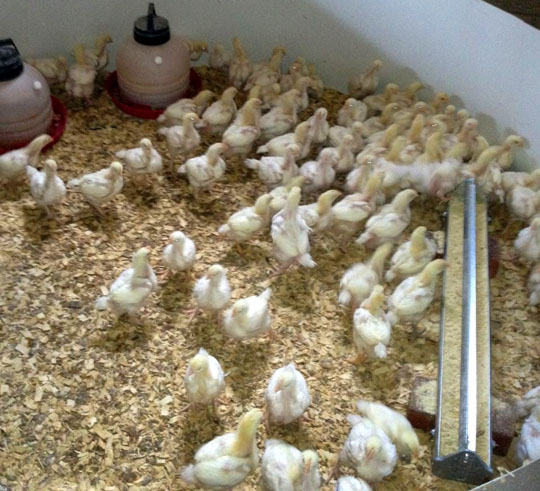
Chickens at 2 weeks, soon to go out on pasture.
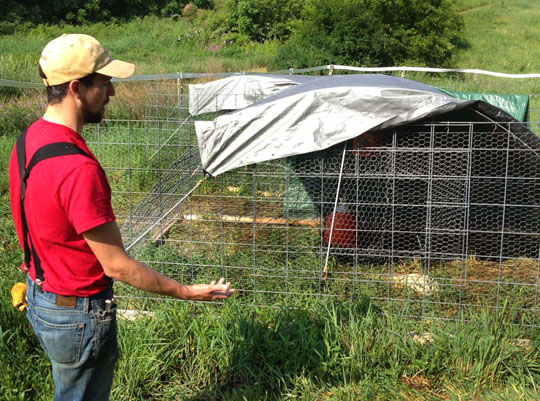
Cramer and the cage that protects the chicks from hawks but allows them to graze.

Where the processing happens. Because he processes fewer than 1,000 birds a year, Bradley does not have to adhere to government regulations, which typically don't allow for fresh processing.

The chickens are put head-down into the funnel. They flutter and flap going in, but once they're inside they seem to grow disoriented and don't move or struggle.

To kill the chicken, you pinch the craw and windpipe, slide a knife vertically through the neck behind them, turn the knife 90 degrees, and cut the main arteries. They immediately bleed out. As I said, it's not fun to do, but it is over very quickly.
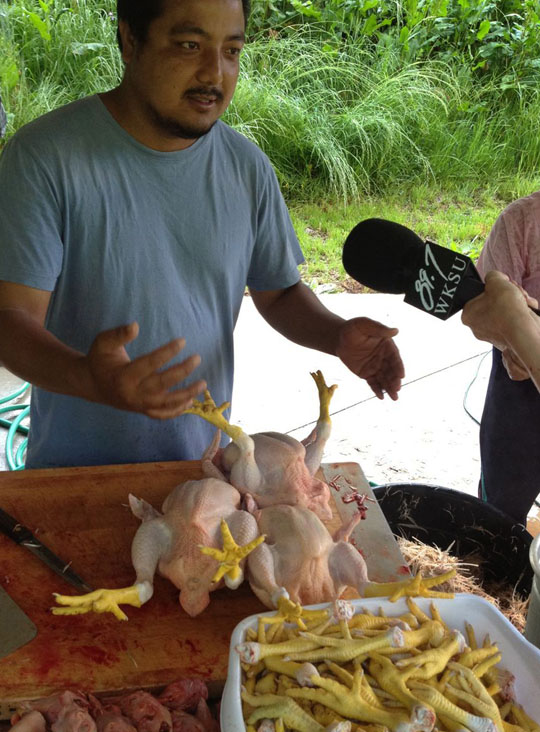
The birds are scalded and put in the defeathering spinner shown in the video; they're then moved to the processing line. Vivian Goodman of WKSU radio interviews a Burmese refugee who has been relocated to Ohio.
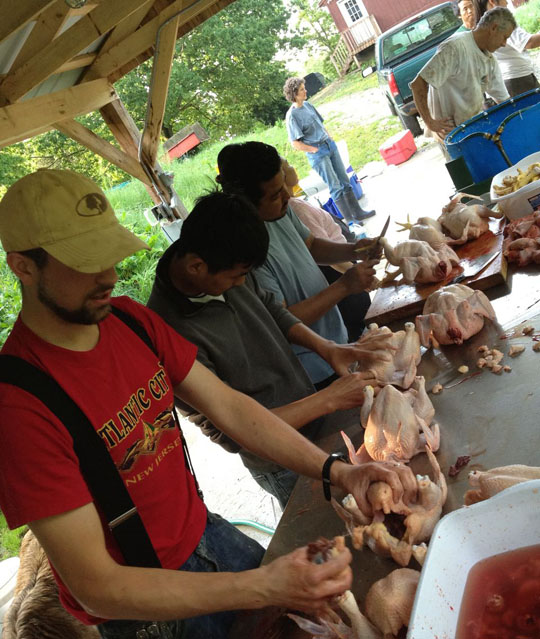
Head and legs are removed, then the viscera.
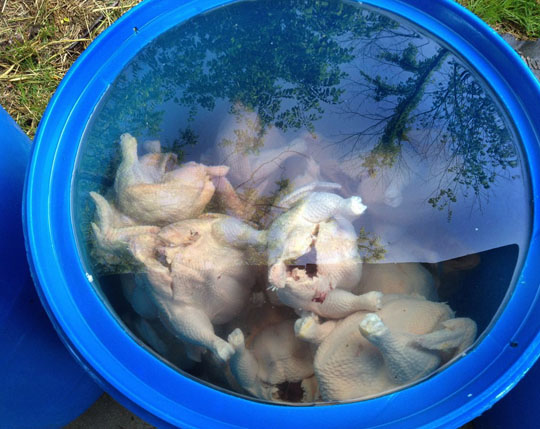
They're chilled first in ice-cold water, then moved into an ice bath where they are quickly brought to below 40 degrees.
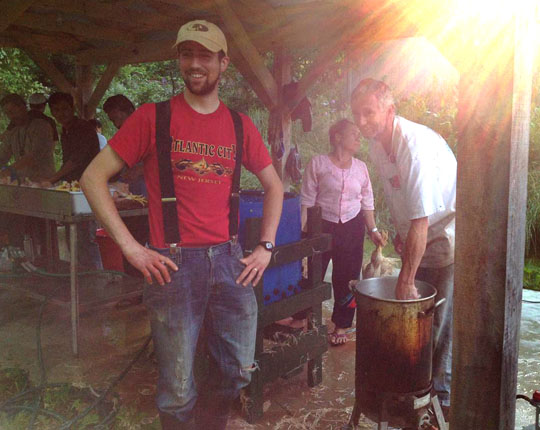
Thanks, Bradley, for helping to educate me on the life and death some of the food we eat.
If you liked this post on processing chickens, check out these other links:
- My post on the Whole Hog.
- Chef Edward Lee discusses the importance of slaughtering meat and how it connects us.
- Shop for local meats at Heritage Foods USA.
- Civil Eats is a great resource to learn more about food policy and politics.
© 2012 Michael Ruhlman. Photo © 2012 Donna Turner-Ruhlman. All rights reserved.
Thanks Michael, this was a timely post for me. My family raises our own meat birds and my husband, two sons and I processed 12 last weekend. Most people I know are totally grossed out by this, but I think it's important. My kids don't take the meat we eat for granted...it's hard work and a very sobering experience to kill an animal for meat. We understand where our food comes from and, I think, that makes us appreciate it more.
Excellent post. This is another question I ask myself a lot when it comes to the question of eating animals... because honestly, I don't think I'd ever be able to bring myself to be the one holding the knife. Ultimately, I think I've decided that's ok as long as I'm mindful and respectful, but I can also see how that would sound like a major cop-out.
Kudos on bringing some awareness to the food we are eating and how it ends up on our plates. These last couple posts have been really well written and illustrate why we should be invested in where our food comes from and how it is prepared (meat or otherwise). I think a lot of people would be surprised with the amount and availability of naturally produced food around them if they actually took the time to look in to it.
Some pretty good information.
A few tips....
I use a poultry killing knife (a very narrow 1/4" wide knife) and dispatch by inserting it into the mouth and cutting the vein, it's much less messy.
I cut around the anus and pull it away from the body before inserting the knife up inside along the skin (sharp side facing the skin) and then make the cut outward, there's much less chance of contamination.
It's not a good idea to cut into the cavity in a way that they do, there's too much of a chance of puncturing the intestines.
I hope they're saving the feet/legs (as well as the heads). : ) They're essential for good stock. If you also scald the feet/legs, most or all of the skin will peel off in the plucker.
An old fork makes a great lung remover. Put about 1/4 of an inch of the tine end of the fork in a vice and bend it over, it works just as well as expensive lung removers.
Lastly, and maybe most importantly, one must be very careful not to cool the birds down too rapidly because it'll cause cold shortening making the meat extremely tough, that can happen with ice water, rather than just ice.
From Britannica.......
"Cold shortening is the result of the rapid chilling of carcasses immediately after slaughter, before the glycogen in the muscle has been converted to lactic acid. With glycogen still present as an energy source, the cold temperature induces an irreversible contraction of the muscle (i.e., the actin and myosin filaments shorten). Cold shortening causes meat to be as much as five times tougher than normal."
~Martin
I'll make sure Bradley sees these comments, many thanks.
Interesting about the cold shortening. i can say that the chicken I cooked from that day was perfect.
Martin- Thanks for the tips. I always like to hear about new and different methods. Also about the cold shortening, that is very good info. I'm glad I know about it now. And yes we do save the feet and heads. They made a wonderful stock!
Looks like you have a great set-up there.
We started raising pastured poultry in large numbers not long after Salatin first published his book in '96.
Plans weren't available for that style of plucker back then, so we had to make a several thousand dollar investment in an Ashley plucker and scalder......things have come a long way since then.
~Martin
I so do love that you posted this! I was concerned when we processed our chickens last year as my (then) 7 year old stepson had never been around the process but HAD been around the chickens as babies... and I was so so so proud when he looked at me up to my elbow (literally - it was a 6 pounder) in chicken pulling out guts and exclaimed proudly that it "looks just like the chicken at the store!". And now he knows where food comes from and I get a helper this year 🙂
Love that remark, looks just like that chicken at the store!
I spent some time researching meat breeds, looking for other options to the cornish cross, which have lost so many of their natural instincts in the interest of getting a harvestable bird in 6 1/2 weeks (!). I'd be happy to have them live a little longer (slower feed to meat conversion) to have a more "normal" bird. But I had no success. I instead raise "dual purpose" breeds that lay eggs but are "heavy" and harvest the roosters when they get to a good size. There is a market out there for an alternative meat bird breed, if anyone is listening. Would love to have a graphic of the throat cutting move. I always struggle with how to get through the feathers easily. Great post.
do you know about the Freedom Rangers? we get a similar bird from Meyer's - they are the red broilers. nice and meaty and more chicken-like than the "creepy meats" (cornish x's). after 3 years we still have two of the red broiler hens - and they are still laying. but raised right you can pasture the cornish x's - we've kept ours as long as 4 months and they were monsters.
There are at least a couple alternatives available. The Red Ranger and the Rosambro.....
http://www.mtdifarm.com/index.html
One of my goals is to someday breed a bird that's slimilar to the French Poulet de Bresse......someday....I hope.
~Martin
Whether you are a vegetarian or an omnivore, it is important to see and know what really happens on a farm. And...I must add that this farm you've shown here probably does their processing in a more responsible way than some others do theirs. But the bottom line is, another life lays down so that we, the big/bad bipeds, can live another day. Once you fully "get it", your sense of humility and gratitude is permanently altered
yeah, humility and gratitude are critical components in this whole big equation.
"Head and legs are removed, then the viscera"
The viscera - is that the parts that should get put back in? I like to see the parts put back in the chicken for use and I'm not seeing that in the photos.
I have been using all of them and even saving the fat for confit. I just made a large batch of chicken leg confit and it's just as good as duck to me.
I treat the tiny hearts with care, marinating in shallot and sherry to saute, deep fry the gizzards and use the liver in pate, or saute with onions, or course the bones and neck go into stock.
All of the skin (all) gets turned into cracklins in my house, I keep it salted crip and ready to top on a salad or any dish to make it better.
This is all very good eating and it makes the killing part a little easier if you can put the entire animal to good use.
The parts (viscera?) are my favorite thing to eat now, not the lean breast meat, a lot more flavor is in the parts.
Thank you for the great documentation of the process.
The viscera are all that is removed from inside the bird, the giblets (edible viscera) are what is reserved.
Great article and great reminder of where our food comes from!
I finally got to the video, great job. The bird looked ready to cook when he got it cleaned, I'm curious as to why and what part of the process of mass produced chickens the water is introduced to the meat. I know the air chilled chickens have a lot less water content and better flavor, but some of the factory farmed chickens are plumped with water and - I was told bleach.
Interesting article. I'm impressed he can sell such high quality birds for that price. It's also great that they're helping others get into the business. Hopefully, there'll be enough people raising chickens this way that they'll be much more available. A farmer near me gave up on chickens because it cost too much to raise them the way the Schmidt's do. He used similar techniques. It's a shame, because the birds were delicious. Fortunately, he has a thriving business selling bison which he also raises organically and humanely.
I have been curious about the slaughtering part of meat eating. Butchering gets tons of coverage but writers and the media treat slaughtering as a dirty thing that gets done but that people don't like to talk about. This was really instructive, not that I am going to go out and start raising chickens. Killing is part of meat eating and I would love for you to find a hog farmer and write about hog slaughtering.
A few questions popped up for me, you mentioned that chicken growing is seasonal, how so? My assumption was that with the way Bradley raises them they would not survive in the wintertime. Finally, what is it about the breed that makes them grow so fast and is that necessarily a good thing? Some of the commenters have suggested otherwise.
This was a great piece!!!!!!!!!!!
Thanks for this story and pictures. When my steer is slaughtered in a few months the rancher asked me if I want to attend. I didn't hesitate. Scary and I have no idea how I will react, but I am determined to go. Lucky you to get to have even more experience than just watching. Also lucky to have such an amazing price for pastured chickens. In Northern California they go for around 6.00lb which has put chicken out of my budget for now. Believe it or not my grass fed beef is cheaper. At least we can still get chicken livers and gizzards for a decent price.
true heroes of the people! feeding, teaching and sustaining!
We raise our own chickens every summer, about 8 a batch and it is very humbling. I can't say that we don't get attached, they are pretty endearing if not bizarre animals. I'm so glad we are able to raise our own meat in the summer, it really gives me humbling perspective AND respect for the animals we consume. It's easy to go overboard when all you see is packaged meat, but when you see that they were living breathing animals, you, like I said feel more respect.
Thank you for posting this!
Don't have any specific comments. Just want to add my thanks because I know there are many out there who take a negative stance and don't see the connection between slaughter to Styrofoam and Saran Wrap . I wanted to express appreciation for showing the harder side of the equation in a respectful manner
http://www.answers.com/topic/chicken-in-every-pot
Familiar with the "chicken in every pot" quote (often attributed to US President Herbert Hoover, but apparently it's an old phrase that refers to prosperity).
Plump tender poultry used to be a luxury food (meaning occasional, unless one was wealthy). The value perception of changed with the record-busting grain surpluses, thanks to the adoption of industrial scale grain production and harvesting. So the higher price of pastured and small scale harvesting more closely reflects the true cost of poultry than does the price of the artificially cheap industrial perversion that most Americans consume.
My state tried to encourage small, sustainable poultry raising operations by investing in a mobile, fully equipped slaughter and processing facility. It also met standards for State and federal inspection, so birds processed in it could move freely in commerce, unlike uninspected poultry.
Sadly, good intentions AND hard work by those involved were not enough to keep it on the road; and it was sold for a fraction of its cost.
3.5 pound chickens used to be kind of standard when I was growing up, and many cookbooks still call for a 3.5 lb. chicken in a recipe. But I have not seen a bird that small, other than the little cornish hens, in 15 years or more. The chicken I bought at Kroger today was 5 lbs., which is what you see the most around here. This really increases the cook times on those recipes. I wish there were smaller birds still available.
For the record, they aren't forced to eat rocks, they eat rocks because that's how they digest food. There's nothing inhumane about it. Some birds swallow small bits of gravel that act as 'teeth' in the gizzard, breaking down hard food such as seeds and thus helping digestion.
This info is worth everyone's attention. When can I find out more?