
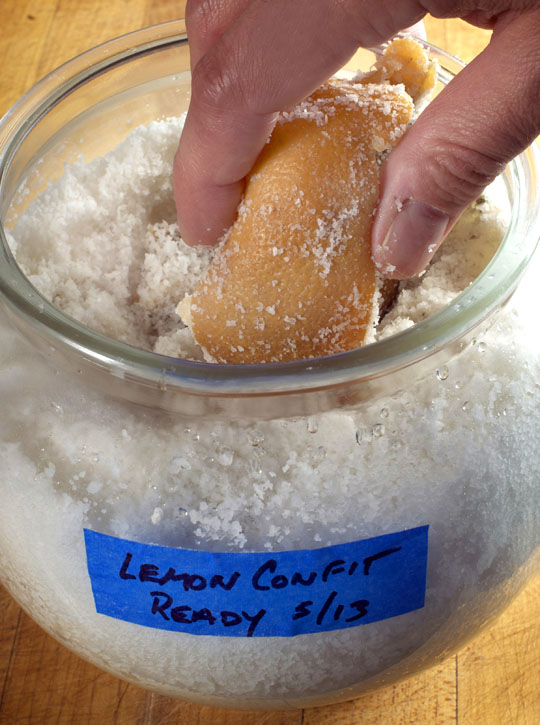
Lemon Preserved In Salt, photo by Donna Turner Ruhlman
With all this curing going on over at charcutepalooza, I thought I'd mention a common item that anyone can easily cure, given enough time. Lemons. Lemon confit or preserved lemon, is a powerful seasoning and a great pantry item to have on hand. A common ingredient in North African and Middle Eastern cuisines, it adds a beguiling lemony-salty brightness to stews, curries, and sauces. It is amazing minced and tossed into a salad, or used to infused olive oil for a vinaigrette or condiment. It also goes well with chicken, fish, and veal. There may be no purer example of salt's transformative powers than what it alone does to the lemon.
The following recipe is adapted from Charcuterie. If you want a sweeter result you can add a cup or so of sugar. Not too long ago I had a batch of lemon confit that developed an air pocket around one of the lemons and mold grew. That batch had to be thrown out, so now I add a half a cup of water or so to add some density to the mix and and I also pack the salt down every month or so to ensure the fruit is completely encased in salt.
Lemon Confit
Ensure the fruit is completely packed in the salt.
- Kosher salt to cover (about 2 pounds/900 grams)
- ½ to 1 cup water or lemon juice (125 to 250 ml)
- 6 lemons, scrubbed and halved crosswise
- Pour 1 inch/2.5 centimeters of salt into a lidded nonreactive container just large enough to contain the lemons and salt. An earthenware crock is ideal, but a plastic sherbet container or a wide-mouthed glass jar work fine. A container in which your lemons fit neatly, without being jammed together, will require less salt. Place the lemons in the container, then pour more salt to cover and drizzle over the ½ cup of water. The lemon should be completely submerged and make sure there are no air pockets around the lemons.
- Cover and store in a cupboard or other dark place for at least 1 month, preferably 3 months. Once cured, the lemons will keep almost indefinitely in the salt.
- To use the confit, remove a lemon half, or as many as you need, from the salt and rinse off. The lemon rind will be tan in color if you did not use lemon juice. Cut in half and scrape out the pulp and pith; discard them. Mince or slice the rind. If using it uncooked (in a salad, for instance), blanch it in simmering water for 30 seconds to remove excess salt.
Yield: 12 pieces lemon confit
Update: Enough comments noting bright yellow lemon confit make me want to revise this and say absolutely, add half a cup or more of lemon juice rather than water. The acid should reduce the oxidation of the skin to maintain its color. For my next batch, I'm going to halve the lemons, juice them, and put the rind, juice and salt together. Also, whiteonricecouple once made me a bracing elixer by juicing a confited lime and adding soda water over ice.
If you liked this post on lemon confit, check out these other posts:
- The Bitten Word shares Chef Eric Ripert's recipe for Broiled Snapper & Lemon Confit
- My recipe for Braised Lamb with Ras El Hanout
- Canning tips and how to make triple sec from Cathy aka Mrs. Wheelbarrow
- David Lebovitz discusses his Moroccan preserved lemons
© 2011 Michael Ruhlman. Photo © 2011 Donna Turner-Ruhlman. All rights reserved.
I am a big fan of lemon confit. Every winter I do up a batch of meyer lemon confit...lasts the whole year.
I made this once in an earthenware container, per the directions in your book. It sat for at least a couple months. There was what I assume to be mold (blue/green) and it stunk to high heaven. The lemons were more brown than tan as I recall and didn't look fit for consumption.
After cleaning the container, it still stunk and I ended up throwing it out. Very disappointing.
Not sure what happened. Could have been air pockets I suppose. I didn't squeeze the lemons first, I wonder if I should have. I also wonder if there was something wrong with the container. What exactly constitutes a "non-reactive earthenware container". Most such things have a glaze, does that present a problem?
I have since seen a similar instruction that involves packing the lemons in lemon juice and salt, so they are submerged in an acidic liquid. That made sense to me although I haven't yet tried it. Interesting you are now adding some liquid.
Is the leftover salt good for anything?
definitely the air pockets, next time add a cup of wateri've heard some use it but i dont, especially as it wet.
I usually add lemon juice to make sure that I have all the air pockets accounted for. I have a prolific Meyer Lemon tree so I make a batch of lemon confit every year and I can spare extra lemon juice to fill any air pockets. These are some of my favorite cured products!
I've done this before with olive oil, salt, and spices like cinnamon, peppercorns, etc. The taste was amazing, but it used a lot of (relatively expensive) olive oil. Can do you preserve them with a strong brine so you can impart some additional flavors?
yes, I'd try a 50-50 brine.
What a coincidence! I just decided to check your website for something on preserved lemons and there you are already writing about them. Both Sophie Grigson (Sunshine Food) and Ghillie Basan (Modern Moroccan) use lemon juice and Grigson adds water as well to top off the jar. I think I'll just go ahead and start preserving and see what I need when I get to the top of the jar....
I go south to my friends in Napa or Phoenix and they let me pick some of there lemons, I make a batch of limoncello for them and take some lemons to preserve in salt. They turn brown over time and I was wondering would a brine preserve the color?
no, they always turn brown.
Don't forget Carol Blymire's post on preserved Meyer Lemons: http://alineaathome.typepad.com/alinea_at_home/2010/12/preserved-meyer-lemons.html
I was wondering about the brown color, too. I just transfered mine from one large to several smaller containers. They smelled good and had no mold, but were very brown.
normal
I love preserved lemons!
I do mine a little differently, cutting the lemons into 8ths. My cure has less salt, and, rather than water, lemon juice squeezed from the lemons. The lemon wedges are easy to pack into jars, and the consistency of the salt/lemon juice mixture ensures no air bubbles, and makes it easy to completely cover the lemons, which is essential to curing and preventing spoilage. The lemons always remain a beautiful, bright, sunny yellow. Would love to share the ratios/method if you're interested!
Charity
I would like to know the ratio/method, and have you kept them for long periods of time? Thank you
hmm, i wonder if, given enough acid, they might retain their color.
I have had lemons in kosher salt for about three months now (following your recipe). The lemons are brown and the salt on the bottom of the container definitely has some liquid in it. Are mine good to eat? They smell fine, but the skin is brown on some of them. My jar has had a lid on it, perhaps that is the issue...
The lemons will be brown/tan.
fine to eat. only bad thing is mold.
wow I haven't thought about a confit in a long time, but I do love preserved lemons! Thanks for this post.
Use meyers lemons. See David Lebovitz blog of last year.
I make preserved lemons in a similar way with great results. The key difference are using more water rather than packing them primarily in salt, then after putting them in a jar, I top the mixture with some plain olive oil. The oil adds a little bit of flavor, and also acts as a seal to help prevent spoilage. My lemons stay pretty yellow even after months.
i love the idea of covering with layer of oil.
Thanks for featuring our post about broiled snapper!
I make mine a bit differently but also top with olive oil after 7-10 days of curing....they're never brown and I haven't had a problem with air pockets.
1/3 cup kosher salt and 1/2 cup fresh lemon juice per 2 thin skinned lemons.
The one thing that has kept me from making lemon confit is eating the skin of non-organic lemons. Scraping the skin doesn't quite do it for me. Tho organic ones are easier to find now that WFoods carries them more regularly. No prob for you folks in CA or FL!
Could you use this method on limes or other citrus?
Shouldn't the jars be cleaned and then sterilized in the oven first? Couldn't that deter them from forming mold? -Thanks
It's not really an anaerobic environment and salt concentration takes care of bad bugs.
Can you use oranges or limes? What about using sugar instead of salt does that work?
Cantonese people do this with kumquat's, which they later use to treat soar throats, so I'd say it works with other citrus.
I use Paula Wolfert's preserved lemon recipe with great success every single time.
http://www.epicurious.com/recipes/food/views/Paula-Wolferts-Seven-Day-Preserved-Lemons-15336
The lemons remain a bright yellow. They're packed with a strong brine made of fresh lemon juice and kosher salt, and it only takes a week to begin using them. I've never determined if they could last a year because they rarely make it past six months.
Just finished a double batch in time for Lent. I almost feel guilty how wonderful this makes the "sacrifice" of eating more seafood 🙂
I use lemon juice with the salt and store the finished product in the refrigerator. They keep indefinitely (and do stay bright yellow), but after about 6 months the texture gets a little gloppy.
I'm definitely trying with acid. maybe juice the lemons and cure the rinds. and yes, you can use limes as well. don't think other citrus is popular for curing.
Your post inspired me to to a batch of lemons this weekend. One thing I noticed is that there are lemon sections wedged against the side of the jar that are not completely covered by salt. Would this constitute an air pocket and should I repack the lemons?
So I started my first batch of preserved lemons 6 weeks ago using a lemon juice/kosher slat combo in a sealed glass jar. I'm about ready to start using them in cooking but decided perhaps I should wait after I opened them last night - they are still a vibrant yellow and there are no signs of mold but when I opened the container it made a 'pop' sound and started a slight bubbly, fizzy action - the sounds reminded me of uncorking champagne...
Just wanting to make sure this is normal vs. a sign of little uglies crawling around in my lemony goodness!
Thanks!
Mitchal - I made some preserved lemons for the first time around Christmas and had the same little pop over the first few weeks I had them out at room temperature. They were fine though. This stopped once I moved them to the fridge as the recipe I was using suggested I do after a month or so.
Thanks for the heads up!
Wanted to make sure before I threw some Meyer Lemons into the brink as well.
I’m impressed that the date on your jar does not have a year (5/13). We started adding the year after things were working their way from the back of the freezer or pantry and we were left wondering, May of what year? We try a lot of new things and can sort of overwhelm the storage capacity.
I should chime in on limoncello for this post, it's easy peasy lemon squeezy:
Peal the lemon and use the zest leaving as much of the white pith, add to Everclear 190 proof for best results, or vodka, just enough to cover the peelsl Let sit for a week, shaking every other day.
Add simple syrup, at 2/3 sugar to 1 part water.
Done.
Store in freezer and serve after a nice meal. Let it sing the L.L. Cool J. song to you ...."Momma said knock you out ...!"
can you use the salt after the curing process??
I have two ice cream containers full. It seems like the liquid always comes out. They always turn brown. I've used them and had them over a year..
"...or used to infused olive oil for a vinaigrette or condiment."
should be
"or used to infuse olive oil for a vinaigrette or condiment."
Bought a fresh batch of organic lemons and have them in a brine with lemon juice topped with olive oil, beautiful bright yellow now, keeping my fingers crossed.
Also use the leftover lemons after juicing or peeling for limoncello, put them in the microwave for 2 min. and let sit for 1 min. cleans great, then pulse that leftover in the garbage disposal for fresh lemon sent. Talk about getting some mileage out of a lemons!
I used some "natural' salt from our coop. It was from Colorado or somewhere, and when I tasted it (after using 5 pounds of it in a earthenware crock for only a dozen or so lemons) it seemed gritty to me. It was pink; maybe the extra grit was from the lovely red rocks out West?
Anyway, I've used a couple of lemons, always trying to zest them, which obviously didn't work, since they aren't really firm. Now I see that I should just make thin strips after rinsing them and removing the pulp. So far I'm not a convert, but maybe using them the 'right' way will make a significant difference.
I'm hoping the salt can be reused, and that my impression that it really is gritty is a fantasy. Who would sell salt with sand in it?