
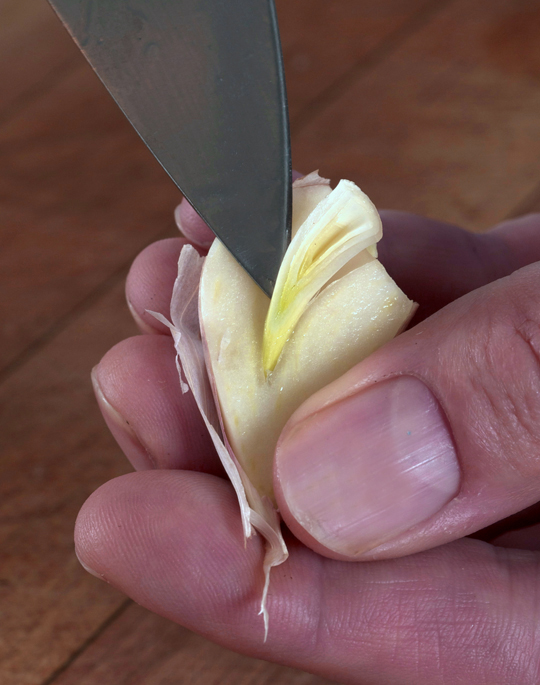
I'd long been taught that the germ of garlic released enzymes that changed the flavor of garlic. In Skills class at the CIA in 1996, my chef instructor said in the finest starred restaurants you'd find that the cooks removed the germ before mincing, but that for our purposes it was unnecessary. That same chef, 5 years later, now asked his class to always remove the germ because it did affect the flavor. Harold McGee discusses garlic and its science in his book.
I too noticed differences, not that the garlic was bitter, as some claim, only that if the garlic sat for a while before using it developed to me an off flavor. This blogger did a test finding that the flavor was different but not worse, in fact that the garlic with the germ tasted more garlicky.
The way I handle the germ is simple. If I'm prepping the garlic ahead of time, I remove the germ first. If the garlic is going straight into the heat, I don't.
I asked friend Emilia to look into it and the research on the germ itself is inconclusive, but not on how the power of garlic works. I'd love to hear what other folks convictions are on the garlic germ.
by Emilia Juocys
Facts about garlic:
- Garlic is a member of the allium family, whose other members include onions, leeks, shallots, green onions, ramps, scallions, etc.
- It originated from Central Asia north of Afghanistan.
- 12 million metric tonnes of garlic are produced globally a year.
- China is the world's leading producer, exporter and consumer of garlic.
- Is key component in Asian, Mediterranean, North African, Middle Eastern, South and Central American cuisine.
Books about garlic and onions
If you liked this post on garlic germ, check out these other posts:
- Recipe for garlic soup from the Smitten Kitchen
- James Beard Foundation shares the classic Provencal dish Chicken with 40 cloves of garlic
- Todd & Diane from White On Rice Couple share their Garlic Noodle with butter recipe
- My garlic post from this past summer: The Best Garlic
© 2011 Michael Ruhlman. Photo © 2011 Donna Turner-Ruhlman. All rights reserved.
Sometimes when I put chopped garlic in butter it turns a blue/greyish color. It doesn't look that way in restaurants. How can I stop this from happening?
That's a reaction with iodine, usually from salt. Use unsalted butter and salt with kosher/pickling or other non-iodized salt.
Paula.. Here could be some reasons for the this reaction.
Your garlic maybe too young. It may need to be aged longer.
Are you using any copper? The sulfur in garlic reacts to copper.
Type of salt? Iodized salt can make garlic change colors.
hmmm. i've seen that blue-gray stuff come out of my garlic press. i thought it was some kind of funky mold/rotten garlic bit. i never thought it might be reacting to something... interesting
I ALWAYS take the germ out. Pardus taught me that, and it forever changed me. I have a saying, "Always take the time to peel your celery and de-germ your garlic"
What an interesting post. I've never de-germed my garlic. However, hubby and I are both lovers of the intense garlicy flavour.
For raw use I will de-germ on garlic that's old enough to have a distinct germ, for cooking I only de-germ if the germ is very pronounced. New fresh garlic that I pull from my garden I never de-germ. Mm fresh garlic!
I was taught to remove the germ from the garlic so it would keep longer. Also, we used to sprinle a little salt and grind the garlic with the blade, and I am sure that added a bit of preservative as well. As for flavor - the reson you have a germ in the garlic is because it is on it's last legs, or it is not stored correctly. I usually never have thsi problem, because I look for garlic that is plump, and I store it in my cold room.
At the hotel though, I don't have that luxury, so I have the cooks remove the germ. Works like a charm.
Here's a link to an old thread on Chowhound that discusses this...
http://chowhound.chow.com/topics/311387
Personally, if Jacques Pepin says it is not necessary to remove the germ, then I don't.
I trust Pardus over Pepin.
So, I guess that's why roasted garlic is so sweet and un-garlicky ... the compounds never mix. Thanks.
Like Iliana above, I only de-germ when the garlic gets old and starts to sprout out.
You got it!
Are we talking dormant germ here or an 'active' germ on the way to sprouting?
I never remove the dormant germ, but an 'active' germ can have off flavors.
I pop active cloves in a clay pot on the windowsill for green garlic.
I read somewhere that if raw minced/chopped garlic is not exposed to oxygen it could turn toxic. Oxygen prevents it from turning toxic. So mixing raw minced garlic and butter can be toxic. I have eaten raw garlic and butter before reading the article and I am still alive! Is there any truth in this?
garlic can produce botulism if left in an anaerobic (oxygen free) environment. It can also happen but is more rare with other members of the allium family (onions, shallots, etc.), but is less likley.
If kept under refrigeration, you dont run the risk of contamination.
Three-Cookies,
I think that you may be referring to the danger of botulism poisoning from fresh garlic in oil.
Yes, It is a real danger.
I love garlic, sometimes I will get rid of the germ, but most of the time I don't. I think it dose not make much of a difference the flavor changes but only slightly. however I do agree that peeling your own garlic is better. thanks for this post I really in joyed it.
that`s very interesting and useful post! sometimes my garlic change its colour during heating and now I know why 🙂 thank you!
I have trouble finding garlic that DOESN'T come from China. Even my local farmers' market sells Chinese garlic. 🙁
As for cooking garlic, I don't understand why most recipes tell you to add the garlic along with any onions you're sweating. The garlic ALWAYS burned when I followed those instructions.
I also have trouble finding garlic that does not come from China, and I live about a 100 miles from Gilroy CA, the "garlic capital of the world". I don't get it.
Interesting discussion. I've got a bed of red toche garlic growing in the backyard right now. Can I stand the wait for four more months?
A lot of people freeze garlic. What are the ramifications for frozen garlic?
You can freeze chopped garlic and whole clove unpeeled garlic (just take a clove when you need it).
add me to the "i remove when it's about to sprout" crowd. otherwise, i just chop garlic as is. i prefer to use my chopped garlic immediately. pre-chopping and storing just makes it taste less fresh (well...it IS, less fresh if you are waiting to use it)
but, ruhlman, do you know why shallots taste bitter if you chop them in a food processor? I find shallots taste unpalatable unless i have taken the time to carefully, and thinly, slice by hand....
i don't get it...but i stopped asking why and stopped taking shortcuts here....
i don't know, i only know that shallots in a food processor blow
I tried to make homemade mayo with egg yolks, olive oil, coarse chopped shallots, salt, lemon zest and a wire whisk, on vacation with minimal supplies... it blows.
I personally can't taste the difference. Adam Perry Lang always recommends it, but his rubs, marinades, brines, etc. Have so many other complementary flavors that I can't imagine the germ imparting any off-flavor.
I learned the hard way. I chopped the germ with the rest of the clove for a recipe. I didn't notice much difference when we ate the meal, but the leftovers..yuck! The garlic got stronger and the odor was terrible. It seeped through the container so my refridgerator just stunk. I had to throw the leftovers away and throw out butter that wasn't wrapped tightly that absorbed the flavor. It was awful. I degerm always, now.
This time of the year it is hard to find good garlic, sadly I resort to the large plastic container of peeled garlic, and I googled how to preserve good garlic, but nothing compares to fresh garlic at the peak of season, when it's plentiful and robust. We have a garlic festival at the end of summer with an amazing variety of garlic, I pick up a couple of bulbs of each - one to plant myself and one to use for cooking.
If your buying garlic with no root hairs it is more likely from China, U.S. garlic does not have the machinery to remove the root hair and cut it smooth. You can still find good garlic from south of the border, usually hard neck with purple color to the paper, in a good organic food market like P.C.C. in Seattle area but this time of the year 4 months I use fish or chicken with sun dried tomatoes and peeled garlic with some calamata olives a slice of lemon and a splash of wine, make a pouch with aluminum foil, seal the edges and bake for 15 minutes, very forgiving and I plant or toss the garlic if it has a protruding germ.
If I am using garlic in a salad dressing I remove the germ. If the germ has any green color, I remove it before cooking. Much of the garlic I buy is local and has very little developed germ; in that case, I use the entire clove. Garlic rarely gets pre-prepped in my kitchen although after reading awhile ago about letting it sit for 15 minutes, that is a practice I now adhere to. This post has started great dialog - thanks!
I haven't seen it mentioned above, but garlic is super easy to grow. You can purchase varieties with different flavors and storage attributes. There's a little difference in which type of garlic is best suited to your region (general rule of thumb: hardneck in the north, softneck in the south), but it's something that can be grown anywhere. Seedsofchange.com has great information (NOTE: I have no affiliation with seeds of change).
If Garlic (or any other produce) is too old, I toss it over the fence for the jack rabbits and Javelina to munch on. "De-germing" seems like a silly, fastidious exercise to me. I doubt I'd ever know the difference one way or the other.
I like the Gilroy garilc festival for garlic ice cream. I like to make a parsley, olive, caper and anchovie sauce for fish, or a quick ceasar salad dressing when garlic is in it's prime.
and my favorite is slow simmered butter with loads of garlic, strained and used for pop corn or garlic bread.
I agree with Digging Dog: If the garlic is active, as in beginning to sprout, then its composition will be changed and it will be on its way to funky. The dormant germ is rarely noticeable and won't need to be removed, though if this makes the cook feel better, nobody else will mind the extra effort.
I don't see why this needs to be an either/or discussion. If I'm braising something and throwing some whole or smashed cloves in, then I see no reason to pull out the germ. But if its something like a gremolata, where garlic can overwhelm, then I think a removal is a good idea based on this analysis.
What are your thoughts on sprouting onions? Use as is or de-sprout?
I used to do this off and on, usually when it was green, until my mother in law while cooking one day insisted that it must always be removed. I'm not too comfortable with "always", especially when I don't get to make up the "always", extra especially for something that I've found absolutely insignificant in my cooking,
So now I always leave the sprout, germ, whatever.
I have no training and I've never seen a discussion like this one. Yet, I always remove the germ and I always prepare my shallots with a knife. Kinda nice to get some unexpected validation! : )
As for when to add garlic during the cooking process, one can often tell if the recipe author has actually prepared the recipe by when they tell you to add the garlic. Adding garlic in the beginning of the cooking process unless done at extremely low temperature almost always results in a burnt offering to the garlic gods.
I always sautee my aromatics first, then add the garlic about 1 minute before they are done and sautee until it becomes fragrant. I also sometimes mix a little olive oil with the minced/ pressed garlic before adding it to the heat to add a little insurance against burning in a hot pan (this works especially well with a wok).
Since I cook with garlic almost every day, it behooves me to know more about it. Very interesting. Thank you.
LL
Last May, The Experimental Cuisine Collective in NYC hosted presentation "The Culinary Chemistry of Garlic, Onions and Related Plants with Rabi Ann Musah of the State University of New York at Albany".
After listening to the presentation and the Q&A, I did some home experimentation and firmly believe in the 10-15 minute timeframe for the maximum garlic flavor.
The good news for home cooks, I believe home food cooked with fresh ingredients (garlic or onions) cut 15 minutes before use, will be superior to restaurant food that uses mise en place prepared hours earlier.
Cd
I'm so glad you wrote about this.I always preach removing the center stalk of the garlic. I am 100% convinced that THAT'S what makes garlic indigestible to many people. If all those people who claimed they couldn't eat garlic would just remove it, I don't think they'd have a problem. Whether I'm cooking the garlic or using it raw, I never DON'T remove the center stalk and along with it the thin membrane that surrounds it.
This may be looked down at by serious chefs, but the garlic paste in a tube is pretty good and works in a pinch, along with the anchovy paste. I use it for Caesar salad dressing and try to keep some in the fridge for emergency use, when the garlic is dried out or sprouted.