
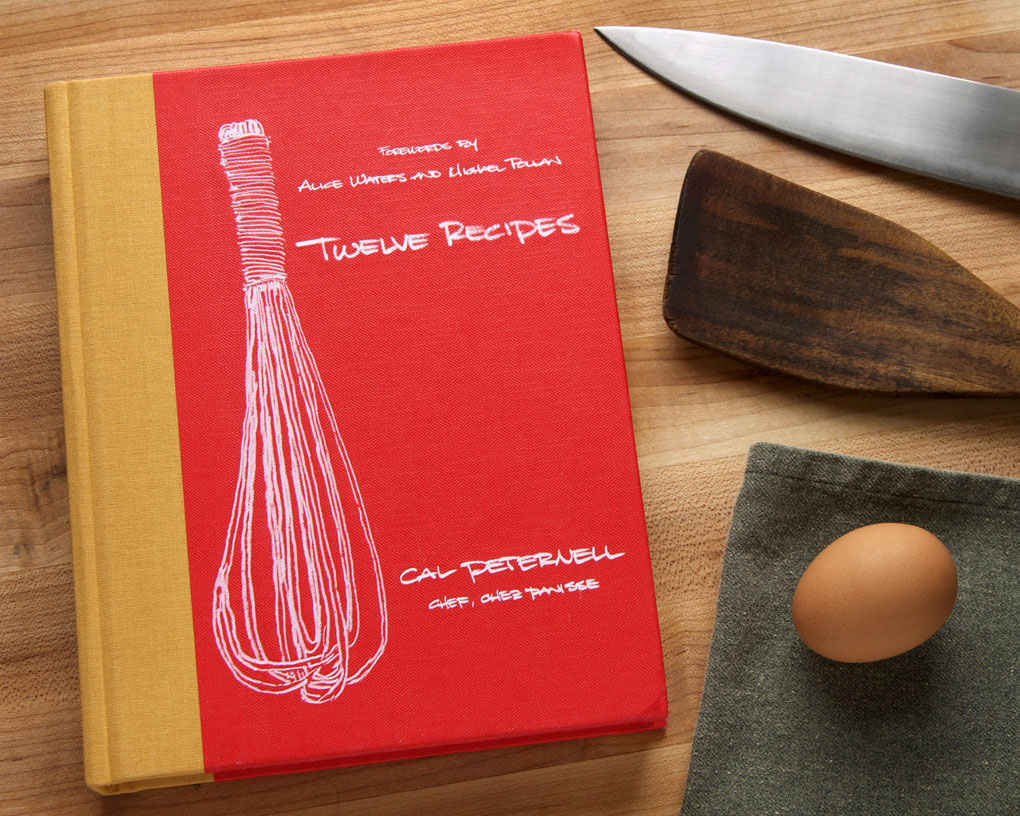
Photo by Donna Turner Ruhlman
I want to call attention to a cookbook after my own heart, a cookbook that seeks to encourage and teach the few fundamental ideas on which all cooking is based. It’s called Twelve Recipes by Chez Panisse chef Cal Peternell, and it came into being out of the love of a father for his sons.
Peternell, on returning from a family trip to Europe, wondered why more cooking wasn’t done at home, notably and especially by his fellow chefs. He understands: fatigue, time, the desire to see new restaurants. But he also knew this:
“The ancient acts of gathering foods, cooking them, and then coming together to eat are as profound as any that we do, and as pleasurable.… I consider cooking and eating with my family my best skill.”
Yet he’d failed to teach his kids to cook. And so he wrote this book, and it’s excellent.
Sam Sifton said it best in his NYTimes review: “Rare is the cookbook that acknowledges the simple truth that there aren’t really all that many recipes in the world. There is just technique, and practice, and joy and love, and at the end of it something simple and delicious on the plate, something that the reader may not have considered making before cracking the spine of the book.”
As Sifton notes, the recipes here are narratives, as the best recipes are. A really good recipe is a story. And of course Peternell includes not just twelve but rather numerous recipes, and variations on those recipes, but his title emphasizes, as I tried to in Twenty, that all of cooking rests on a small but powerful base.
The first chapter is called "Toast," the second “Eggs,” the third “Beans.” One is called "Roasted Chicken," from which so much can be learned. I love his “Three Sauces” chapter, which describes the underappreciated-at-home Béchamel, as well as Salsa Verde and Mayonnaise.
The book is beautifully designed, with homey photography (everything seems to be rustic these days!) and lovely watercolor illustrations.
And it’s thoughtfully, honestly, eccentrically written. Meaning we get a full sense of the chef’s personality as well as his personal cooking convictions. In the “Pasta with Tomato” chapter, he describes a marinara variation called “Arrabbiata.” Though the term typically translates as “angry,” Peternell writes, “I prefer ‘enraged.’” And so in the list of ingredients is “Enough red pepper flakes to enrage and not engulf.” I love that. I love that he wants his kids to know how to make a cake. Everyone should know how to make a cake.
I love this whole book—even though he does tell his kids to put vinegar in the egg-poaching water (Kids! Don’t tell your dad I said this but it’s a bad idea!). And I want to give one away because it's so damn good. I want to spread its exuberance about cooking food and sharing it with the people we care about, one of the most important and profound acts of humanity.
To win a copy of this book, write in the comments below a dish or technique that teaches more than the dish or technique alone by Thursday (comments will close at midnight).
Happy cooking!
Other links you may like:
- My past posts on Meat Broth and Stock, Hoppin' John, and Annie's Caviar Pie.
- My holiday 2014 cookbooks picks.
- If you're looking for another great book to learn how to cook, one I wrote describes the all-important concept of Ratios.
- Two other blogs to check out are The Culinary Life and Vanilla Garlic.
© 2015 Michael Ruhlman. Photo © 2015 Donna Turner Ruhlman. All rights reserved.
The ever elusive, seems so easy, scrambled eggs!
I want to buy this book for every high school senior who will be graduating from our youth group this (and every year). What a great teaching tool.
Bolognese! It teaches how to layer flavors, manage heat and know when to stop.
Making stock teaches many lessons. Knife skills, deglazing, defatting, foam removal. All useful skills and things to do.
Temperature. I am a novice in the kitchen and I wish I could find a good book or site about how to work with heat and temperature when cooking food. Knowing this would really help me cook things correctly in the kitchen.
I love the technique of confit. It is so versatile, and though you frequently see it with duck, it really can be applied to anything including vegetables. One of my favorite things to do is put a bunch of garlic, herbs and spices into any confit, then use the flavorful garlic to make a compound butter. Or, just make garlic confit - or tomato! I confit food all the time and incorporate it into a variety of recipes, from using a garlic, onion and calabrian chili confit paste as a base for salsa verde, to making confit tomatoes for a pizza topping. It is so fun and delicious, and always impresses people.
I find the making of a simple flour, water, yeast and salt bread to be lessons in patience, texture, adaptability, timing, hope and enjoyment.
Omelette! So many different ways to to make it your own. However, I believe the omelette on its own serves as a great reminder that it's the simple things that keep life in perspective!
Braised meats. No one technique makes so much savory food.
Making Stock and subsequently turning it into Demi-Glace
So many lessons including:
- Knife skills
-Allowing ingredients to provide their own flavor with minimal spices.
-Patience in the kitchen, because you can't rush stock. Ever.
-How to make something you can use to make many things.
I agree with the comment about making stock, it teaches a variety of things, but most important it teaches patience. You can't rush a stock and in the end you realize that good things do come to those who wait!
Baking bread! You gotta learn to trust your gut.
Curing: the process of preserving by salt. It teaches me patience, precision, and promises future gratification!
makind a mayonnaise by hand in a bowl with a woo den spoon and watch all the ingredients combine and become more than the sum of its parts Magique Sensual
Braised short ribs. Braising can be used for so many proteins. And learning to brown your meat, deglaze your pan...utilize cooking on top of the stove and then transferring to an oven.
Or making a pan sauce. Browning & deglazing once again. But finishing a sauce, emulsifying with cold butter. Making something flavorful with every aspect of the protein you cooked with.
Roux - especially for young kids to start making their own mac and cheese.
¡Tostones! - twice fried green plantains. You slice them, fry them, smash them and fry them again; Peel green plantains (hard green, not yellowed or ripe ones) best to slice lengthwise along ridges then peel back the hard skin. Cut into 1 1/2" chunks and fry in vegetable or canola oil. Once nice and golden (5-7 minutes) remove from oil with tongs or a slotted spoon and lay on a cutting board. Now the smashing, if you don't have the hinged gadget a "Tostonera", simply use the base of a tuna fish can. Smash down slowly and flatten. Once all are flattened, back in to the oil they go for 2-3 minutes until golden and sun-like. Dry on paper towels and serve with salt and hot sauce. Now….for the oil, do NOT throw out; cool it and pour it back into the bottle through a coffee filter in a funnel. As slong as you're not frying fish, or other flavored items you can reuse the oil many times this way.
Mac-n-Cheese…teaches how to make a basic béchamel, baking and salt management.
This book sounds great. I second the idea of stock. I make it once a week. Also, the basic "mother sauces" are something I return to often. I've gone grain-free so I'm trying to modify the sauces while retaining the right textures - and it's great fun, actually. I think that stocks and sauces, plus flavor layering with herbs, fats, and spices are the basic techniques that I use to cook my food all the time.
Braising definitely is my favorite technique to teach. It utilizes underappreciated cuts of meat, layers on the flavor, and doesn't need to be babysat.
Sausage making. Rarely does one "recipe" teach us to respect our food, make it entirely ourselves, and give us the opportunity for helpers in the kitchen. It requires patience, creativity, and is simple. So simple it can be complex. It's a favorite for me and my son to make together and then cook together.
Making soup by sauteeing aromatics, adding stock, other vegetables, and spices, and (optionally) stirring in cream and pureeing is a fridge-clearing technique that works with almost any ingredients.
A simple fried egg. It teaches proper use of fats, temperature control and correct tool selection and use. Taught my son just the other day!
Stocks and Broths. A foundation for cooking everything!
Roasting a chicken teaches us about the deliciousness of simplicity. A good chicken. Salt. A hot oven. Time. Simple. Delicious.
Gumbo! You've got the roux-building, the chopping/sauteing, the simmering, and the eventual discovery that this, like nearly everything else in the world, is made better by being served with a dollop of buttery, peppery grits.
Making a big pot of tomato sauce (sunday sauce). It's so simple yet so versatile: you can braise meatballs, chicken, pork ribs, braciola - any meat really - in it. You can toss it over noodles and make a delicious pasta. You can use it as a condiment on bread. Throw a little over eggs. There's a reason why our baba's slaved over a big cauldron of it every Sunday!! Its magic!
I'll put in a word for pasta, since it's on my mind (a FB friend described the disaster of their teenage child trying to make homemade pasta). Attention to the texture and feel of the pasta as it forms from eggs, water, and flour teaches you about trusting your senses and acknowledging the power of atmospheric humidity. That, of course, also applies to cookies, bread, and a number of other dishes.
And it helps develop patience, if you have trouble with the other two concepts. 😉
Building soup/sauce bases with soffritto or battuto . How the finely chopped vegetables slowly saluted really make the foundation for great flavor in nearly every soup and sauce.
Risotto- there are so many ways to build and expand on flavors or how it can be used as a base for something much more elaborate that highlights its rich texture and complimentary flavors.
A simple loaf of bread -- flour, yeast, salt, and water.
A simple roast chicken. Learned skills:
1) Poultry anatomy and dispatch: I butterfly mine out and trim well so I always have wingtips, keel bone, feet and other "parts" for...
2) Stock/broth-making: "juicy and gelatinous goodness"
3) Seasoning: under the skin to get the flavor in, oil/butter on the skin to promote crispiness... roasted atop...
4) Veg cleaning and prep: bird is roasted atop root veg that collect some of the meaty goodness
5) Deglaze and gravy makin' - methods for using the fond/pan juices
6) Resting... all proteins need a moment
7) Carving the critter... then plating
8) Give thanks and chow down!
9) and lastly, but not leastly, how to wash dishes and pots.
...and giving the animal respect by utility of any and all pieces/parts
To me, the quintessential dish that teaches more than just the recipe is a bolognese ragu. I began making this primarily for my girlfriend, who studied in Italy and lamented what passes for meat sauce most places in Cleveland/Ohio/The U.S. I am an early-30s home cook, and this ragu taught me many things about cooking:
- Quality ingredients make all the difference. I can whip up this sauce with grocery store "meatloaf mix," or, preferably, I can go to a butcher and get mortadella, pancetta, and fresh-ground beef/pork/veal. It's good with the grocery store stuff, but It's AMAZING when I take the time to get what it needs. Same goes for garden carrots and garlic, and for pairing this with fresh pasta vs. dried. Same cook, same technique, vastly different results.
- Even with the best ingredients, preparation matters. People always say things are "made with love," and I never knew what that meant until I took the time to dice the vegetables in this sauce as fine as possible after being disappointed with chunky carrots in an early batch. I recently bought a mandoline, which makes the job easier, but even before that, I would put in the work to make sure the textural elements were right -- that is cooking with love.
- The burned bits are gold. I believe you've covered this quite nicely in your recent fond post.
Making a bechamel or veloute sauce -- figuring out the basic process of making a roux, then adding liquid to create a sauce is such an instructive process in itself, and once you've learned to do it, it's a ticket to understanding so much more. Like making a quick pan sauce or gravy (I didn't really understand gravy until I learned to make veloute), or making casseroles from scratch.
A proper omelette! There's quite a bit that goes into making a great omelette, starting with the beating of the eggs down to the motion in the pan as to avoid browning and ruining the consistency of the albumin.
Beef stew. I have this oldish cookbook that has a fool proof stew recipe. One day it dawned on me how many techniques, etc were there to be learned in that one recipe, even if it didn't say what they were. That would have been too scary for the home cook back in those days.
An omelette. Like you said in Egg, it's what so many restaurants will use as a test for technique and attention to detail. It shows heat control, pan control, knowing when to stir the eggs and when to let them rest and form around the curds, etc.
I think most importantly of all, though, and this should apply to ALL cooking, is that you take the best ingredients you can and then do as little to them as possible. The ingredients will create amazing food as long as the chef has the attention to detail to do just barely enough to let that shine through.
I'm also in the Gumbo fan club. The mise en place of having all the aromatics chopped (evenly!) first, the patience of stirring the roux until the perfect color appears, and the knee-buckling wonder that is the aroma of aromatics hitting the hot roux. It is my pinnacle dish to make.
Mayonnaise! This basic emulsion teaches a technique that is used in dressings and even Hollandaise, but also leads the way (at least in my opinion) to more advanced skills like liaison, custards, etc. I would consider this a fundamental skill that can lead to so many other, more elevated techniques.
Mayonnaise - I felt like I did a magic trick the first time it came together.
Any kind of dough--bread, pie, cookie--the wonders of it all.
A basic broth can be a great teacher about how slow and easy can develop amazing flavors that can enhance any meal
Pan Fried hamburgers. A simple meal, but one that both teaches proper sanitation and temperature control. Understanding both are essential!
Soup - it teaches you to taste, taste, taste and patience
Any mode of egg cookery. Especially for me, making an omelette.
Roasted vegetables: knife skills, oven heat/time management, applicability to multiple dishes or several meals from one cooking session, balanced seasoning, healthy eating
Fried chicken! First you make the brine for the bird, then the butchering of the chicken into parts, the frying itself, and then, if you make it ahead of time, the continued warming, tenderizing, and maintenance of crispiness in a low oven (preferably convection). Even the eating of it requires some careful technique if you don't want to make a mess of yourself!
Stock - teaches layering flavors - teaches respect of animals/vegetables used by using every part of the ingredients grown or purchased - teaches patience - teaches how one product (stock) can be prepared so many ways - and have such a wide impact on so many others - everything from boiling potatoes to making sauce to boiling pasta in it - it's a great foundation for everything else!
I had recently read the NYT review of this book and definitely saw that was a kindred to Twenty. Maybe the most useful thing I came away with from Twenty was the pan roasted pork tenderloin with garlic, thyme and coriander. I've made that specific recipe many times, but the technique it teaches can be used for all sorts of things, and I've substituted/added to the ingredients with great success using fish and chicken and even Brussels sprouts. I recently cooked up a pan roasted chicken breast with bourbon, maple, butter pecan sauce which was born out of the pan roasted pork recipe. If there are just 12 recipes, I'm sure one of them is essentially this technique.
Cooking an egg dish - it can be accomplished in so many ways. I love them poached, soft-boiled, fried, scrambled, baked - it is hard to imagine a way in which an egg couldn't be cooked -- and not only is this ingredient versatile, but mastering the many proper techniques of cooking an egg will stand anyone in excellent stead their entire life.
Braising teaches patience, the importance of proper seasoning.
Barbecue: Taking those tougher cuts and rendering them infinitely tender through brining, rubbing and cooking low and slow
As a beginner in this area, making classic French stew allowed me to see how many layers of flavor you can get with each step. Also, baking bread is also a huge educator on patience and experimentation!
Bone broth! The base for so many dishes.
Preparing Coq Au Vin (I was inspired watching Top Chef the other night) teaches proper braising technique and the development of rich flavors, which also allowing the few ingredients to create a deep and wonderful dish.
Making a basic loaf of bread taught me as much about cooking as almost anything else. I'd been told and read that the big difference between "baking" and "cooking" was that the former required strict adherence to the rules (hydration formulas, proofing times, etc.) while the latter was far less restrictive. What I learned from many mediocre results of breadmaking attempts was that the rules matter, but being alert and thinking matter more. Paying attention to the reality of what was happening to the dough was more important than adherence to a recipe. By persistently working at making a decent loaf of bread, I learned how to use the recipe as a guide, and to focus on what was actually in my hands.
Bread- no matter the recipe, you still need to really look, smell, feel, taste (hear as well since some people thump on the bottom of loaf to test doneness) at every stage of process. And it can come out slightly different each time due to weather, variations in grain, etc. It's a great intro to trusting instinct in the kitchen.
Chicken Pot Pie teaches making stock, prepping vegetables, making a roux, poaching chicken, the art of creating flaky pastry, and the importance of patience. Most of all, it’s such a comfort food from my childhood, it teaches love.
Wrong time of year to be thinking about it, but... grilled ribs. Teaches about long cooking with indirect heat and the wonder of melting connective tissue, sauce reduction, potentially about how smoke can add flavor, and of course it helps teach about the wonder and beauty that is pork. Mmmm, ribs....
Hi Michael! My youngest daughter, Edie, who is eight, really has an affinity for cooking and baking. She loves it and is good at it and we spend a lot of time together in the kitchen. She asked me to teach her to cook more complicated things, so I've been using your books as a tool. She hates math, so I've been teaching her ratios, and how to cook with them, and then from Twenty, techniques.
I see just from teaching her, that teaching the technique not the recipe, is the thing that is going to go with her throughout her life. The recipes you forget but the techniques stick.
Anyway, this book sounds great and perfect for us right now, Am excited to read it and cook from it with Edie. Thanks, Michael.
Butter sauce.
As a new cook - with no formal training - I was in charge of making brown butter sauce ever day for 6 months. That particular task turned into the most stressful time of my day. During that time I learned to make, break and fix any emulsified sauce - from vinaigrette to aïolis. I couldn't be more pleased with the skill one recipe taught me.
I often use poached chicken as an introductory class for Kitchen Confidence clients. It's an old technique that's well over-due for a renaissance. It teaches us how to cook with many senses, how to nourish ourselves with healthy, delicious food (even the lowly boneless, skinless breast, if you must). It also teaches the cook once - eat twice lesson. You get beautiful protein that can be used in sandwiches, salads, potpies, soups. You get an tasty poaching liquid that can be used to enrich soups, sauces, stews.
It's also a method that flies in the face of "cooking is too hard" "cooking takes too much time" mentality.
If I don't win this book, I'm buying it. Sounds like a keeper.
pan roasting anything. If you can learn to sear something in a pan and follow it up with aromatics, veg and spices and finish it in the oven there's no limit to the number of recipes you can create
I would love a copy of this book for some guidance in teaching my two boys to cook! I do it all, and they do not ask any questions or show any interest,
And I forgot the dish. Roast chicken, for sure.
I guess I'd pick making a pan sauce. If you can throw a pan sauce together it elevates any protein in your dish. There are so many ways to flavor one and are really quite simple.
Soups and Stews! Both are a great way to learn how to use leftovers, as well as using the crock pot. The use of the slow cooker is the best way to make a hearty, one-pot dish without degrading the use of fresh foods and prep skills. It also keeps up with the demands of a modern lifestyle when there is no time out every to cook. I learned this from my mother and I am teachinging it to my family now! Keep Calm and Cook On!
Bread, it teaches
Patience while waiting thru the rising
Getting your hands into your work with kneading
Details and chemistry having the right ingredients, amounts, temps to get the reaction you need
Love of the simple things, nothing is better than creating and sharing a simple loaf of bread
Mayonnaise, simple and pure. Teaches how to handle eggs, and whisking. Also teaches the importance of quality ingredients.
This book and Twenty would make a great companion set.
I think a basic Chicken Noodle Soup is a great way to teach a wide variety of skills - knife work with celery, carrots, and onions (mirepoix or chunky style), working with garlic or shallots, poaching/roasting chicken, making a stock, the use of salt (and/or vinegar) to season, and how to boil, season, and shock noodles to keep them from going squishy in a soup. Really ambitious cooks can even make homemade noodles. Chicken soup is also a great place to experiment with herbs, or even learn where you can sneak in a shortcut or two when time is tight. Finally, it's an easy recipe to adjust by switching up the pasta for grains, transforming it into a cream soup, or adding in different veg.
I have always found making gumbo from scratch encompasses many different techniques and skills that can be used in many dishes. I generally make a chicken and sausage gumbo with a black roux. The task begins with breaking down and deboning a whole chicken (1), then using the bones to make the stock (2), which simmers for a few hours. I follow a Prudhomme family recipe which calls for lightly breading (3) and frying the chicken (4); while that cools, knife skills are practiced on dicing up the vegetables (5). When all the ingredients are ready, making the roux (6) is the delicate part…I want it dark, dark brown, but not burnt. Then I brown (7) smoked sausage to pull out extra flavor; the veggies are then added and cooked in the roux; the chicken and sausage pieces added to the pot along with the stock, and the simmering begins. Meanwhile, I cook up a pot of rice (8) that will be served with the gumbo. So, 8 techniques are employed for the one dish. I suppose learning to mix herbs and spices, and when to add them, could also be another technique, as would making and smoking the sausage, if anyone wanted to go that route. All in all, gumbo is fun to make and the results are a feast.
Knife sharpening teaches patience, respect for the tools of the trade and a passion for perfection. All of which are the essential characteristics of a culinary craftsman.
Homemade stocks great foundation.
A widely used cooking technique that covers so many different foods, fermentation. Adding those foods together would be a charcuterie plate masterpiece with plenty of refreshments to drink alongside.
Stock and soup...they teach patience, Preparation, and planning. They aren't quick to make and if you don't pre-plan you may end up missing a key component. Stocks also teach recycling...
Picadillo - - a Cuban peasant dish that consists (varyingly; peasants can't be picky) of ground beef, onion, garlic, cumin, black pepper, chopped Olives and raisins (and maybe a splash of red wine vinegar). Usually served over rice. It teaches how balance and complexity can bring a dish to life, without being difficult to make or enjoy.
Gluten free baking - it teaches the science of what property each gluten free flour brings to a baked good in order to properly find the best flour mix for each recipe.
A hamburger: Buying & seasoning meat, controlling temp to balance crust & doneness, produce, seasoning & saucing (salt & mayo)
Making risotto! The process of making risotto (if done all from scratch) teaches stock making skills, knife skills, patience (all that stirring and time), balancing flavor, seasoning, and also the skill of using the correct cooking temperature. Then it teaches you to use some restraint since you want to eat it all as one serving!
Soup. It's an Art. It teaches the importance of texture, comfort, balance, soul, sass and restraint. If you can't make good soup, you can't call yourself a Cook.
A white sauce was the first thing my mom taught me how to make (after I graduated from reading directions on boxes around age 9) and I was very impressed when she listed all the things I loved to eat that she said I would be able to make by knowing this. Plain sauce for vegetables, cheese sauce for vegetables, or macaroni and cheese, (using ANY cheese, wow!) gravy for fried chicken or other meat dishes, it wouldnt be white if you used the pan drippings but would be tasty. Surprisingly, it was needed for salmon croquettes, which I adored and the american style casseroles which regularly stretched leftovers with pasta and vegetables. She informed me, if a recipe had 'cream of something' soup, I could use white sauce instead and it would be nicer. Or if I wanted cream of anything soup, start with the white sauce. But no, I may not use the blender on my own.
As a culinary student, I learned the slightly more elaborate béchamel, but as a 9 year old, my mom taught me about white sauce.
The omelette.
Stock, stock, stock. Even something as easy as a veg stock is so easy to do and so essential to increasing the quality of a home-cooked meal. Besides, instead of just throwing all your veg into the pot you can use the opportunity to practice your knife skills! Veg stock doesn't need a perfectly diced carrot, but it sure looks purty when it has one!
Any kind of roast ... first searing you learn about dry, high heat and the wonders of the maillard reaction, then a slow braise teaches how moist, low & slow heat breaks down the connective tissue to create something fork-tender out of an otherwise tough cut.
Yes, the maillard reaction! My boyfriend and I always talk about turning "America's Test Kitchen" into a drinking game and taking a drink every time they reference this fantastic piece of kitchen science. (But we always end up watching it in the morning, and don't want to go down that "drunk by 10am" road, so the game remains unplayed.)
Braising meat. Not only does the final result end up so much more wonderful than the sum of the individual parts suggest, but there are so many techniques involved: chopping, proper searing, deglazing, temperature control, etc. And the flavors can be as simple and complex as you want them to be. I'd love to give this book to my sister-in-law who is just starting to learn to cook and needs some encouragement!
Hollandaise - it teaches how heat can affect an ingredient, how acid can brighten a dish, and a lot about the science of emulsion. Plus it transforms humble ingredients into a product that's far more than the sum of its parts.
Braise just about anything. Easy to do, but so much to understand to know how to make it the best it can be.
Norimake...not only do you need knife skills and the know how to cook the perfect rice but you learn to balance flavors and textures with the add-in ingredients. This was the 1st dish my grandma taught me to make as a child.
Roasting. One can roast just about anything. It brings out the richness, and depth of flavors of a food, whether it be meat or vegetable. And, there's the prep for roasting, using knives, oils, and seasonings, most especially salt. What a lovely book. My boys need to learn how to cook.
Vinaigrette-you learn about emulsion, you make it every day, you save a TON of money making your own and you avoid the junk that is often used in bottled dressing.
Brownies, because no matter how bad they turn out we still love them.
Eggs, from scrambled to poached to how and why they are important in baked goods. All kids should learn to scramble or hard fry an egg.
A simple chicken soup can be translated to so many soup recipes so it's a great building block. Starting with, of course, homemade stock - which is a whole other technique/recipe. Many people have mentioned roux/bechamel, for homemade mac/cheese or tuna casserole, also good and kid friendly placed to start. I love the roux for the obvious alchemy/magic involved, since it shows so well the potential of simple ingredients.
I've got to say Chicken, chicken is such a versatile food. Young and old alike can learn about cooking chicken that can be used for so many different type of meals. A couple or a family could eat for most of a week on 1 good size bird.
Poaching an egg. Once you can poach an egg perfectly, you can do half the things you need to learn in the kitchen.
That would be Roasted Chicken
Biscuits!
They teach you how to work something just enough -- not too much -- and that the most important ingredient in any dish is love.
Soup. The way the humble ingredients you have on hand can be transformed into something nutritious, delicious, and filling. When our Korean mess hall cooks transformed leftover French fries, green beans and roast beef into a new meal I learned the value of not wasting food.
Making the perfect steak. I wanted to know how to do this, and I turned to David Chang's recipe on how to cook a rib-eye. Everything I know about cooking meat is based on that one recipe. Salt it like a NYC sidewalk in the winter, sear - don't touch!, oven to finish, baste with Butter and aromatics, beautiful.
Roasting, once you learn to coat something in a little bit of fat, roast at higher heat until golden brown and delicious you can roast anything! Meats, vegetables, even fruits.
Smoking a pork butt. It teaches about life.
There are no ways to hurry it up that don't affect some part of the quality. That's true of barbecue and life.
Just as if in life, smoking a pork butt will have at least one stall. You come to a point where you just aren't moving any close to your goal, even though you're trying your best. All you can do is power through it.
Finally, and this can be said for much of cooking as well as life, it goes to prove that "the old ways" are sometimes the best way. Yes you can cook it in a crock pot and you could use liquid smoke to get the right flavor, but it just won't be as good as a butt that takes a long slow bath in fragrant smoke, slowly converting it's tough connective tissues into moist delicious gelatin.
Our 4-year-old is just wild about chicken noodle soup. So we make it together from the ground up: roasting a whole chicken the night before, turning the carcass into stock overnight, sautéing the veggies, and salting salting salting along the way. He stands on his little red stool to ask a million questions. I feel like if I can give him the tools to make that soup, he can take them and run.
The most important part of any recipe, is the love you put in it.
The cuban. Teaches bread making, roasting, pickling, and how to not eat.the tips of your fingers off when it's great.
I'm looking forward to reading this.
Making a grilled cheese sandwich: the choice of cheese, the bread, anything else inside, cooking it so that the cheese melts and the bread toasts but does not burn, and that isn't even getting into the tomato soup to accompany it!
Bread. Flour & water. Let it sit for 3 days. Treat it and feed it, and you can have bread. Imagination and a little salt and magic results. You can eat and be full.
Anything with eggs. Leads to so much more, poaching, frying, baking...sweet and savory
homemade sausage - get everyone involved!
I'm from the south and the recipe I'm wanting my boys to learn is chicken fried steak and cream gravy. While it sounds basic it's a dish that has been passed down in many southern families for generations. I'm wanting them to learn their familial history and to be proud of their heritage.
i think soups help you figure out how to make flavors go together...and how flavors change when you treat the ingredient differently before adding (saute, parboil, fresh, etc...)
Spaghetti - bring water to a boil, bring ENOUGH water to a boil. the importance of the salt in the water, the importance of watching for when it is done - and there are so many things that can be cooked by boiling
A hearty broth made using your own brown stock.
- I think it teaches the fundamentals like knife cuts and layering flavor as well as the role that stock plays in making classical food. But it also shows additional flavor that comes from roasting meat and cooking it on the bone. And you end up with a delicious finished product rather than just stock which though essential is not all that compelling on it's own.
I taught both of my girls that if you have some kind of pasta, a can of good tomatoes, and some good cheese, you can make an infinite number of good meals and keep from wasting the leftovers. Each in their turn would help me figure out what from the fridge to put in, how much of it to put in, which spices and herbs would be best, etc. The best thing one learns from this - buy the best ingredients you can find, and let THAT dictate what you cook.
Roasting a chicken teaches many skills, and gives dividends for more such as repurposing, and stock making
Making an omelet teaches you heat control, timing, simplicity, flavor, and even texture.
making red sauce
Chicken stock made from roasting the bones. There's so much which can come from this simple blending of bones and water (soups, stews, sauces, etc).
Roasting a turkey on Thanksgiving teaches people to come together in the kitchen to collaborate and put together a fulfilling meal..and to actually talk for more than 5 minutes at the dinner table. It provides a vehicle for passing recipes and memories on through the generations.
Grilling a steak over a charcoal fire. Cooking the perfect steak is both art and science. To do it right, you learn far more than just throwing a piece of meat over the coals. You learn:
>Meat selection - what cut is most appropriate for what I'm making? Grass fed vs. grain fed?
>Seasoning - what flavor profile to use on the meat? Salt and Pepper or a more complex rub?
>Fire placement and control - how hot a fire? Where should the fire be in the grill?
>Cooking method - direct, indirect (or both)?
>Timing - how long (if at all) should the meat be over the coals. How long should it be off the coals? What is the exact amount of time needed to bring the meat up to the desired temperature?
>Doneness - What is the optimal internal temperature I desire?
So many lessons from something that seems so simple. I have spent many years working to perfect cooking a steak. And understanding the methods isn't the same as executing it consistently every time you cook.
Bread. Some form of bread is a staple in so many cultures throughout the world. Understanding the basic ingredients required for making bread and how they work together, along with learning the technique of bread making, opens up endless possibilities.
Saturday pancakes do not require a big yellow box in the pantry
we favor the Sunday roast chicken. I've taught my kids the easiness of the process-you can't really go wrong. They enjoy knowing their way around the kitchen and knowing a few tricks gives them a license to explore and learn even more! And that chicken goes on to become tacos, or in pasta or salad and the carcass become broth....all in all, many lessons for everyone.
I guess the obvious answer would be soup, where every little step adds a layer of flavor and an opportunity to use judgement.
Homemade Pasta. Absolutely. Pasta is as important as the sauce (if not more), and it's a shame the method isn't practiced more often. I myself have fond memories as a child with my mother and brother measuring, feeding dough into and extruding machine and watching in awe as noodles oozed out. Since then I've adopted a good old-fashioned hand crank. The process was, and still is, extremely rewarding.
The ingredients are as humble as the final product: flour, eggs, salt and oil. Pasta demands time, commitment, patience and (unless you have a third arm) teamwork. In a world where attention spans are on the decline and technology gears us towards a more instantaneous lifestyle, something as simple as homemade noodles can remind us to slow down. Or to be reverent of even the smallest or simplest of things. To take pride in ourselves and our work. Connect with others.
Besides, who doesn't love pasta? It's universally pleasing. It's a wonderful technique that can take on many different forms and set the groundwork for countless varieties of meals.
I learned almost everything I know from making scrambled eggs the slow, patient, creamy way. And my sons are learning about the physics of food by making popovers: a few simple ingredients + heat + structure = dramatic outcome.
Perfectly steamed or sauteed fresh-from-the-garden vegetables. Not under or over cooked. A variety of them, not just the inevitable squash and zucchini served so often in restaurants. I would like my boys to be able to cook with the same skill and care they show a steak on the grill.
It's almost any dish, if you know how to break it down to teach it. You are working on knife skills, preparation skills, cleaning skills and the art of cleaning as you cook, or even the basic necessity of following a recipe. (Which surprisingly most folks don't know how to do...) I like to make casseroles that will build up on all of those skills. One of my favorite is a chicken and broccoli casserole with brown rice. I bake the brown rice, blanch the broccoli, and make the sauce the binds it all together.
The almighty braise! Beef, pork, lamb, poultry or seafood, it doesn't matter. Times, liquids,ingredients and flavor profiles very dramatically, but the technique remains the same. Stews, gumbos, chowders, pot roasts, shanks, cassolet...all essentially braises. Aromatics, proteins, liquids & time. My favorite technique of all!
I think learning how to use my spice cabinet has really elevated my cooking skills. Considering the meat, veg or fruit flavors. Also learning how to use different spices together or create your own spice blends. Letting my taste-buds and nose lead me. Its thinking with your senses in a different way. It can also take the traditional roast chicken and make it something very unique.
Braising. Braising teaches you how to be economical by stretching your ingredients into a dish that can provide several meals. It teaches the transformative powers of cooking by turning tough cuts of meat and vegetables into a rich and tender dish. And it teaches patience, since at the end of the cooking, those several hours of low and slow heat teach you that it was well worth the wait.
Baking - part science, part art. My oldest grandson and I made a lemon roll buche de noel for Christmas. There's a ton of technique involved in making a great genoise and a bright tangy lemon curd.
Searing meats to keep in the juices and flavor is a hard to master technique, but once you've got it down......amazing things happen!
Mac and cheese made from scratch teaches about roux and béchamel.
Stock, in particular, chicken. The learning process is figuring out what parts give the best body and flavor. I like feet and backs. Makes good use of under used parts and the feet give it an incredibly gelatinous body. Then, of course more is learned when you figure out all the ways you can use the stock- sauces, soups, cooking grains, etc.
Emulsions:
-Egg-Based (i.e. Hollandaise, Mayonnaise, Aioli)
-Vinaigrettes
-À la minute pan sauces
It's a delicate dance, balancing acid, fat, water, temperature. Once mastered, the options are endless.
jewish deli classics are my favorite - its my soul food and through it i connect to family history, the migration of Jews to NYC and the intermixing of all sort of immigrant cultures in late 1800's Lower East NYC that make up America todAY....
I make bread with my 10-month old daughter. Not only is she learning how to make and enjoy the bread, but she is learning the values patience and the rewards that it brings. 🙂
A mirepoix is useful for so many dishes. We almost always start a soup with one.
Making popcorn on the stovetop taught me what a ripoff the convenience foods like microwave can be.
Michael, This is a lovely challenge, and I appreciate your writing, particularly your focus on food.
Risotto would be my suggestion to you. Warm, inviting, delicious, remarkably versatile, it can accommodate Winter, Spring, Summer or Fall.
One can dress it up with white truffles, or dress it down with left over veggies.
The nature of the stock will change the essence, the addition of herbs and other flavorings will influence the outcome.
Less straight forward than "Pasta", Risotto allows me to feel like I am really cooking when I'm stirring and stirring and adding and adding.
Just a suggestion.
Bread
Scalloped Potatoes and Ham. This is the first thing my parents taught me how to cook. You definitely don't need a recipe. Just layer sliced potatoes, sliced leftover ham, half moon onions, flour, salt, pepper and butter in a roasting pan. Then fill it 3/4 full with milk and roast for about an hour until the potatoes are done. Remove the top at the end to brown. This is the comfort food that sustained me through college and my bachelor years. Varying the root veggie and substituting bacon make this technique versatile.
Scrambled eggs teaches you to temper your food (eggs) and how much heat to use. And patience. But I think it also allows for a learning curve because instead of being a helpless bystander you can take your eggs off the heat if they're cooking too quickly.
bacon. it teaches you patience, the value of the cooking something at the correct temperature, and frugality - that you should keep an use the drippings.
Learn your herbs and seasonings. You can take a culinary trip around the world with 4 or 5 ingredients just by changing up the herbs and spices. Maybe not exactly, but evocative of a region. Ground turkey, onions, carrots, and celery, for example. Some coriander, cinnamon, and cumin, a few cut up dried apricots or other dried fruit, and you have Moroccan-esque flavors. Replace the coriander and cinnamon with chili powder, exchange the dried fruit for some hominy and peppers and you end up with an American Southwest/Tex-Mex dish.
When you drain the meat, don't throw out the juices! Put them into a tall glass, wait a few minutes. skim off the fat, then pour the jus back into the meat and let it reduce. If you throw it out, you are throwing out a lot of flavor.
I am in the process of teaching friends how to make fresh pasta by hand, since I grew up watching my Grandmother do it for lunch each day. No machines just boards and rolling pins and strong arms to knead. But not only to learn this wonderful art but to show all the varieties of cuts and dishes you can make with pasta and then the sauces that elevate each dish.
Thanks Michael for a wonderful site.
Adele
Roasting of a chicken, then turning into stock, then using that stock in soups, sauces and many other things.
my only 'technique' is to taste and taste and taste and use butter often
Any kind of curing is something that teaches us how to preserve our own food for future consumption. If one can buy their meat from a local farm the whole world can rejoice and the small farm can take little piece back from big brother.
As a professional baker, I've learned to rely on my hearing to tell me that the buttercream whipping on mixer is finished when it goes from a higher pitched 'blurp blurp blurp' sound to a dense, low 'thwack thwack thwack' sound.
The technique of reduction - taking a larger quantity of something that is not so flavorful (like a stock) and reducing it into something concentrated and ultra flavorful (sauce). A very good lesson in this country where most people judge the quality of a meal by the portion size.
Braising! Teaches you how to make a tough cut divine!
A dish or technique that teaches more than the dish or technique can? That's easy. Pot roast, because the dish is centered around such an important technique: the braise. The entire dish, (properly done) done in 1 dutch oven, teaches simplicity, efficiency and taste complexities. The searing of a seasoned roast fills the home with the familiar fragrances of toasted salts, peppers, and other spices, bringing us all back to our childhood when we had it militantly on a certain day of the week, or that special occasion when our grandparents would visit. But more importantly is the technique to allow such efficiency. The ability to take less desirable, tender cuts with more gristle and break them down in a moist heat for tender succulency is priceless, but best exhibited with a pot roast.
I would love a copy of this book! I'm a self taught home cook, with experience in professional kitchens. I love the simplicity of food and have been cooking since I was old enough to reach the stove. My parents lovingly nicknamed me 'Betty Crocker' as a child. When I was five, my mom had a stroke after giving birth to my baby sister and my dad was hospitalized for colitis and had major surgery. I was the parent when our family needed help- and made food from a very young age. It doesn't matter your age or resources. If you want to eat healthy and tasty food- it really isn't that difficult. I'm now in my thirties and still cook most meals from scratch. I love food and love to teach my students and parents that all cooking takes is time and a few ingredients. Thank you for sharing this giveaway!
-Nina
Brown sauce (Espagnole): There's the mire poix, bouquet garni, sachet of the stock. The reduction. The clarification. Then making the sauce itself, often times finishing a la minute monter au beurre. You could go a step further and say Braised Short Ribs...
Go fishing. With luck catch a fish. Clean, scale, and gut it. Season, then pan fry or broil. Garnish if desired. Life and culinary skills merge here.
Basic stock , it needs to be made with care but when done right it enhances every dish it's used in .
My reserve for "Twelve Recipes" is 43rd in line for 15 copies in my local public library resource sharing system.
The simplest instruction - "brown meat" requires so much knowledge and technique. How hot to heat the pan, which type of pan to use, to dry the meat or not, to season or not, to not crowd the pan, to let it sit without fussing until it sears, lest you tear delicate skin, to not let it sit so long that it burns beyond repair.... I can't tell you how many friends I've taught the simple trick of not over-crowding the pan so your meat browns and doesn't steam. Every time they say "Why don't recipes TELL you that??" Indeed.
Making a proper omelette.
Interestingly enough I have been trying to teach my daughter how to cook. She has left home, completed college and now living with a boy friend...sigh! She often will call with a general question like "Dad, how do I cook chicken"? Over Christmas we went to visit and I showed her how how to make Mac and Cheese. There are so many instructional opportunities for this dish. Making the Bechemel provides the opportunity to talk about the 5 mother sauces and how you transform a Bechemel sause to Alfredo. Then there is the selection of cheese, the selection of the pasta and finally accents. You can add ham, bacon, pulled pork or jalepeno pepper. Anyway...my vote is Mac and Cheese. It is a great family meal or a terrific side dish.
My 15 year old son lives on the other coast from me and I usually only see him once a year on holidays. Since his mom doesn't cook often and I believe cooking is a skill everyone should have, I always have him help me prepare at least one meal which I try to use to teach him broad principles.
In 2013, he helped with Thanksgiving. I quartered the turkey and roasted the white meat and braised the dark. This allowed me to show him some basic butchery as well as to explain the basics of both roasting and braising. I had him chop the veggies and aromatics for both, during which I taught him some basic knife skills. He also made the dressing, including baking the cornbread from scratch, during which I taught him that you can eyeball ingredients while cooking, but that you had to be precise when baking.
In 2014, he helped make chile verde, which brought us to braising and knife skills again, as well as how to rehydrate chiles and the importance of salt and acid in making things taste good.
I almost forgot. I also taught him how to make stock using the Thanksgiving turkey carcass.
Any recipe that you teach a child is more than just that dish. It is touching the food, learning where the food comes from, learning to take care of oneself, a sense of accomplishment, and maybe a pretty tasty meal.
RUHLMAN’S 5:3 DUTCH OVEN BREAD
Home-made bread is showy and fancy and a big deal, but it’s also very, very simple. Five parts flour, 3 parts water, some salt, and some yeast. Maybe throw a little bit of sugar in there too, or some honey if you like. Not too much. Maybe take out two oz of water and add an egg.
That’s the first lesson: this isn't rocket science. Flour, water, salt, yeast, and what you will.
And that’s the second lesson, too: you can push recipes in interesting ways by adding a little extra flavor.
And small lessons along the way: use a scale. Another lesson: the flour-water ratio matters; the rest is an implementation detail.
And yet another lesson, from the wonderful Allegra Goodman’s _The Cookbook Collector_: "Don’t doctor recipes. Sugar will only get you so far, and more than enough is too much."
Now, mix it up in your Kitchen-Aid, if you have one, or with your hands if you don’t. At first it’s a gooey, gloppy mess. After a few minutes of mixing, somehow it’s no longer cold and wet and repulsive: it's springy and just slightly damp. It’s *alive*. A little more time and it’s like a wonderful stress ball. Dump it into an oiled bowl, cover it. Let it sit a while, it'll double in size. Biology is fun.
Preheat your oven to *pretty hot*. 400F will do. While you're waiting, slice a couple of onions and brown them in a skillet.
Coat the bottom of your Dutch Oven with a bit of olive oil. Dump the bread in. Strew the top with those onions. Have some fresh rosemary? That’s nice on top. Or a little coarse salt. Or sesame seeds. Or just leave it be -- maybe brushing it with a beaten egg mixed with a bit of water because that looks nice.
Put the top on the Dutch oven, stick it in your stove, bake it for half an hour. Uncover, let it go another ten or fifteen minutes. (No Dutch Oven? A cookie sheet will do. Or whatever you can put into your oven.)
Now, does it look done? If you’re not sure, stick your instant-read thermometer in the bread: it ought to be 200°F. (That’s another two lessons: (a) instant-read thermometers are cheap and handy, and (b) measure twice, cut once.)
Take the bread out, and smell it. Don’t stint. Also, don’t eat it yet: let it cool a bit. Enjoy it. Make it whenever you like. It’s not a big deal (lesson!) for special occasions. Throw the dough into a bowl before kickoff, into the oven at half-time; you'll have tasty fresh focaccia all sliced and ready for the tense drive at the end of the game.
I agree that bread baking is a technique that teaches much more than bread. It teaches the importance of weights vs volume in baking. That time and temperature are ingredients that affect the taste of the final product. That cooking can be like alchemy when 4 simple ingredients turn into a delicious loaf of bread.
Making a vinaigrette. My son loves to experiment with the ratio of vinegar to oil, and to try things other than oil as an emulsifier. Usually, they're great. Some times, not so much
Pasta - the kids learn an awful lot when aging with just a few ingredients.
The thing I think that I've taught my children that is one of the most useful is the ability to cook a meal with what is on hand. To improvise. To create without being bound by what someone says "should" be done. To invent new things!
My "dish" is brewing beer. Many beers state that beer is just "water, malt, hops and yeast." While this is definitely a fact, it seems brewing these days many home brewers and breweries are losing the simplicity of the 4 ingredients fact. If you love brewing or drinking craft beer, try a "smash beer." Single malt, single hop variety, single yeast strain and water. You can brew a world of different tastes and flavors by starting here first and then branching out to more complex recipes. And you get more of a sense of how each ingredient tastes and smells.
I have been teaching my 6 and 4 year olds how to smoke different proteins, . How different brines, wood, liquids and type of smoker from an electrick to green eff, to kettle can make the same protein taste so different. They have been able to learn how low and slow can make juicy, or jerky style meat. My next course that starts this weekend is vinegar and how you can get really concentrated favors from different juices. The girls do not realize they are learning how to cook, they just enjoy eating the finished product
What come to my mind is matzoh ball soup. It is more than technique or a recipe--it teaches family history and cultural tradition. It's all there: the roasting of the chicken for the stock, the chopping of the vegetables for the soup ("Bubbe used parsnips, but Nana only uses carrots and celery"), to the science of the matzoh balls ("floaters" or "sinkers"? Sephardic or Ashkenazic seasonings?). This soup heals the sick, and helps our family usher in the peace of Shabbat-warming us both physically and emotionally. I'm going to finish up the prep for a batch right now...
Bread. Baking one loaf using a basic recipe has whetted our appetite to experimenting with different ingredients and styles.
scrambled eggs which I still am perfecting. Which reminds me, I really do need to buy your book on Eggs!
Hummus! Teaches bean cooking and improvisation! (Also, I've read some excerpts from the book and I'm very impressed.)
a simple omelet. The pan seems to warm up a bit differently every time, eggs don't have the same viscoscity or volume. Trying to consistently make a good omelet takes a small number of ingredients but teaches watching what is going on and thinking about why.
Meatloaf. Beef, turkey or pork. It's all about the additions. Panko crumbs are my new favorite to use.
any bread baking teaches more than mere baking.
Quiche! Pie crust is a good lesson in pastry, and of course anything with eggs is a good lesson.
Salt! You gotta salt food
banh mi--you can make the bread, learn quick pickling, make your own mayo, etc.
SOUPS! (Vinaigrette a close second)
I think it's essential to know how to make a soup. It's like a hug in a bowl, and can be made with anything. If someone gets a hold the technique their possibilities are limitless and delicious.
The most important thing in my freezer is broth. And the best broth in my freezer is smoked turkey or smoked chicken broth. We smoke our own birds and save and freeze the meat. The smoked carcass + wings make the most delicious and rich broth. Smoked bones make the best broth - try it!
Creme anglaise.
Fermentation teaches forethought and patience.
Growing your own tomatoes and peppers, and cooking them down for a sauce with homemade pasta.
I'm torn between preparing eggs and making bechamel. Eggs are deceptively easy to make, yet difficult to master, and can be a meal unto themselves or the finishing touch.
Once you've got a solid bechamel down, the possibilities are endless. Mastering (or, trying to master) bechamel has taken my home cooking to a new level.
When I was teaching my girls to cook, gravy was the one thing that was hardest for them.
I taught my son to bake a whole chicken when he was 8. We didn't put anything on it - just put it in the oven. He called it "blank chicken."
Sometimes the simplest solutions are the best. Works for most all recipes.
He's 28 now. Comfortable in the kitchen, and knows that things can get really screwed up if we over complicate them.
I remember learning to make homemade raviolis with my grandmother. You first had to sit and patiently watch before you were given access to pasta dough, cheese and a fork. My grandfather would make the dough, my grandmother would make the filling with ricotta cheese, eggs, parsley, black pepper and pecorino romano. The dough was light and cut with the top of a drinking glass in circles or a metal ravioli cutter my grandfather made in his tool and die shop. My dad and mom would cut the raviolis. My grandmother would fill them, then I would put the tops on and fork the sides until they were closed and poke the tops for good luck. It was an assembly line at its finest. It was loud, it was systematic, it was quick and it was fun. When my grandmother passed away my family picked up the assembly line tradition and I look forward to teaching the same system to my two little ones. The process was perfected through a love of food and a love of family and togetherness. No better lessons hace been taught in a loving warm kitchen. and dinner was always more enjoyable knowing the work and love that went into making it special.
One of the first dishes my mom taught me was her eggplant parm. In addition to being a yummy dish, it taught me FEB for breading and how to fry. It also taught me how to freeze dishes ahead and how to defrost them to cook later. 🙂
Eggs. Yep. That's all I gotta say. Eggs.
Curry - balancing salty, sour, sweet, and spicy and watching the flavors synergize, evolve, and become more than the sum of their parts.
Any recipe is great for teaching fractions! I taught math to kids as a houseparent by giving them, say, a 1/4 measuring cup and saying "ok, how many of these for a cup and a half of cheese?"
Their grades improved and they got nachos on a Friday night. Total win!
I learned how to make stock by reading Ratios. Now I make stock whenever I can and have learned how to use it to enhance so many dishes that used to be blah.
Patience. Take your time and don't try to short cut the process.
Morning toast...going beyond butter and jam. Cream cheese layered with sliced gravlax and sprinkled with capers...colorful. A drizzle of olive oil, a couple bite-size tomatoes squeezed and spread, a pinch of your favorite herb, and a two-finger dusting of coarse kosher salt...savory. A spread of honey topped with crushed berries, blue or red...sweet!
Every time I make a pot of Louisiana gumbo, I get all of the mise en place and then begin the dark roux. I was taught to put an old penny by the pot to tell when the roux is ready. This usually takes about 45 minutes, which leaves plenty of time for story-telling and watching/smelling the many stages of roux.
Learning to cook a proper steak. Knowing how salt reacts with proteins to pull moisture out is valuable with regard to all meats.
Also the Maillard Reaction. That magical process by which meat turns into meat candy with a proper char, whether it's steak, or a roast, or chicken cutlets.
And finally understanding carry over cooking, whereby a meat will continue to cook even when no longer in the oven, or on the grill, or in the pan.
Master all this and no roast beast will ever be a well done, desert of sadness.
Honestly, how to cook eggs - either as a homey egg pudding dish, which is just steamed scrabbled eggs mixed with chicken stock. But the hardest is the chinese style of scrambled eggs with shrimp.
Has to be candy making ! Sugar n water - two simple ingredients n technique of boiling.... What one can get at each stage is just amazing! Pure thrill for d candy maker n d kids 🙂
Of course there are many, but Duck Confit. Butchering, seasoning, poaching, storing, frying and let's not forget eating...
Many thanks to you Michael for sitting across from me at The Black Star Farms Harvest dinner and encouraging me to go for it in the kitchen. I've taken your advice to heart and enjoy all the new discoveries and food. Truly.
for me it would be pour over coffee. To make a truly great cup it isn't just about you it's also about the care and attention everyone from the farmer on up. Making a good cup of coffee takes attention and patience.
Bread. Teaches patience and making decisions based on the senses.
You can beat egg whites many ways, for instance using a stand mixer with the whisk attachment. But if you follow Julia Child's instructions from The French Chef television show and beat them by hand in a copper bowl with a large egg whisk and a comparatively smallish bowl, you learn about the interaction of the eggs with the copper, and how using the right size tools can be very helpful.
I've learned a lot about the science of chocolate through making ganache. Temperature, fat ratio to liquid, crystallization, bloom.
Time,
Make the time. Plan ahead.
Taking the time to grow or shop for fresh ingredients and high nutrient dense fruit and vegetables.
Taking the time to prepare, serve and enjoy.
Save time by planning ahead, being organised.
Time the essential ingredient.
Making bread. It teaches patience, working with the dough, and understanding when things are done (the knead, the rise, the baking, etc.). You may be following a recipe but you have to react to your creation each step of the way. There is no way to hurry and you may watch the clock while baking, but you know when it is done not by the clock but by the smell and the look.
Broth. Or stock. Or the name du jour for the magic stuff that time and saved bits can render. Teaches? Patience, frugality, and healing.
The wonderful technique of making bread in my cast iron Dutch oven. Always wanting to share the bread, thinking about the history of what was made and by who in my vintage Dutch oven prior years. So much thought into one loaf of bread each time.
Extracting coconut milk from scratch. This task is a simple one. a thing we chef usually delegate to less experienced kitchen worker. but to truly extract the goodness of coconut milk from scratch, it will require a lot of patience and proper technique to get that fabulous and oh so creamy milk. we all can do a simple dish using this ingredients and have different tastes for final product all because of this very crucial and yet very simple step. define labor of love. 🙂
Garden fresh tomato sauce. Blanching, peeling, seeding tomatoes. Sweating onions and garlic. Reducing these to a rich sauce. Seasoning with salt, pepper and fresh herbs. When does it become about more than the recipe and techniques? When the tomatoes and maybe more of the ingredients come from your garden. Then it teaches that one small seed and a bit (depending on the year) of patience can grow food that is delicious and healthy and amazing.
Hello - I shall try to be brief.
Last night for the first time, after reading and preparing, I followed your instructions-how to make perfect scrambled eggs. Boyfriend was hungry and about to have something frozen and awful from TJ's. I said "NO."- just wait a moment and I will make you scrambled eggs.
Followed instructions to a "T" and what I made was delicious, beautiful to behold and simply sublime. Boyfriend swooned, ate every morsel (even the toast was perfect) and we were both very, very happy. And now I know how to make PERFECT scrambled eggs. Thank you!! I plan on making everything in your awesome book.
Not sure if this was what you meant but wanted to share with you regardless. Thanks, you rock.
Quiche. It's the home cooks gateway into all things custard. And now I recognize that whenever I use a cup of dairy and an egg, I've made a type of custard. Made lasagna tonight. Ricotta and egg = custard. French toast = custard. Sometimes I even make custard just to eat custard. :-).
Passion
It is about the passion you have about cooking. It is about looking in the fridge and pulling a meal together with what you have. I have passed on my passion to my kids and I know they will too. This cookbook sounds like a keeper. I own 39 cookbooks, I love them all.
Cheese. Like bread, it teaches patience, appreciation, life and love.
eggs Benidict and red beans and rice, mostly Eggs Benedict, all the way.
Our family loves the gallette. The technique is very simple and wonderfully satisfying to prepare; a savory 3-2-1 pie dough loosely brought together with your hands. Roll it out and you can fill it with anything from a classic preparation of sautéed leeks and potato with herbs and parmasean, or (our favorite) leftovers! We often follow up a roasted chicken on Sunday with a chicken, mushroom and herb galette on Monday. Add a simple salad and it's near perfection!
Canning. Planning ahead, preserving, patience, low acid vs high acid, transforming something that will spoil in days into something that will keep for months.
Braising - almost all cultures use the technique (how many different ethnic dishes can be made with short ribs alone), so many different types of dishes use the technique (soups/stews, pasta sauces, ratatouille, etc), and you can use the technique with almost any ingredient. Plus it teaches, preparation, layering of flavors, patience... basically it's awesome.
Keep it simple. Make it your own. Don't be afraid to experiment. A recipe is a guide, not set it stone. Someone else's recommendations. We are all different, and have our own individual preferences. Take fish. You don't want to overcook it. Get fresh, quality fish. Salt and pepper to taste. Make a simple sauce - say lemon juice, honey, a little wine, a little chilly, cilantro and/or spring onion. Hot pan, hot oil. Fry skin side down. Pour sauce over. Cover. Rest a while. Done.
Tacos - because they are so simple virtually anyone, especially fledgling cooks, can make them and be successful. There are endless variations and they demonstrate how wildly creative one can be and how delicious the result. I think tacos show how texture impacts taste.
Scalloped potatoes. Everyone loves them, and the technique of boiling the potato slices in the cream until it thickens from the starch in the potatoes is useful and simple. The dish can be varied with all sorts of spices, herbs, and vegetables. I have added fennel and other root vegetables to the dish, seasoned it with chives, sauteed garlic, rosemary, and spring onions. This dish can be varied forever and still maintain its heart warming creaminess.
I'm grateful for beans. It wasn't technique for us then. It was survival. Plain and simple and filling, with a pan of hot cornbread in a cast iron skillet. Many years have passed since then, and I still love a big pot of beans. My beans have grown-up with me, to include onions and garlic, tomatoes and Peppers, along with veggies that I never dreamed of as a kid. The dish may have evolved, but that feeling of security bubbles to the top when I'm cooking beans.
Making lasagne teaches a lot. U have to have just the right amount of cheese to make it taste perfect. And be careful theres not too much tomatosauce. Using different herbs and spices makes it taste a little different each time but it´s still lasagne.
Eggs.
One of the simplest foods we have, but can be transformed into so many things -- from humble to ethereal -- anything from a simple hard-boiled egg through scrambled eggs and quiche and on to silky sauces, decadent custards, clear up to feather-light meringues and macarons.
They appear in almost every cuisine on the planet in all their different forms, yet we sometimes take them for granted.
Jambolaya, it uses so many techinices and senses from start to finish. It has many variations and styles none of which are"wrong".
Adding butter to a pan sauce. Slowly swirling cold butter into an already reduced pan sauce adds so much more than flavor. It enriches the texture of the sauce - slightly thickening it and making it silky and tongue-coating. It enhances the entire experience.
I would say bread, because it teaches you patience. You can't skip waiting for the yeast to work -- you have to wait. You HAVE to. I love that.
I take a leap of faith every time I make mayonnaise. The recipes make it sound so easy, just mix an egg yolk with some lemon juice or vinegar and beat with a whisk or whizz in the blender and slowly add oil. It doesn't always work and I end up adding another, and sometimes another yolk. I can exhale when the slow stream of oil starts to emulsify. This process teaches me patience, that some things have to be done right in cooking for them to work, and that, as with so much both in the kitchen and beyond, doing something, again, and again and again, it gets easier and better.
Braising, like in life, a slow, gentle approach, and paying attention to how things combine produce the best results.
I agree with so many of these great comments. In particular, the ones about braising, pickling, and making a dish your own beyond just following a recipe. I'd like to add the idea of "practice" meaning doing something over and over. You quickly realize the complexities in even simple dishes.
I'm going with pizza on this one. Not only is it my favorite food ever, but I feel like when you eat pizza you can taste how much time and effort (or lack there of) has been put in. From the dough, to the sauce, to the cheese, to the toppings...there is something for everyone and, quality reigns over quantity.
Stir-Fry.
It's not only a basic technique that underlies a number of simple and tasty Asian dishes, but relies on Think and mise en place, because once you start things rolling, you're working with high heat and can't afford to ignore the ingredients for long.
And just as Cal uses Twelve Recipes to teach his children, Mom taught me many of the basics.
Mise en Place.
Don't cut corners. Do it. Don't think "I won't bother to cut that butter into pieces and put it back in the fridge." Just do it.
Don't think, "I can mince garlic in a heartbeat," because you can't - not with everything else going on.
And I don't care what all the TV chefs say about making this or that meal in 30 min - they have everything portioned out, chopped, minced, whatever, before the cameras start rolling.
Mise en Place has been the hardest thing for this stubborn old cook to learn.
For me, it is baking - because demands that I slow down and take my time and be accurate. Now only if it applied to the rest of my life.
Risotto. It's a lesson in patience and feel for how to prepare the rice to be al dente and creamy, with the right amount of seasoning and cheese.
Challah the ritual of baking it every week the kneading the braiding the baking.finally gathering with family blessing&eating,
For me its Grilling. I enjoy getting the kids involved in the prep and working the grill. With the grill it's always a little different, you really need to pay attention. I also find standing around outside is a great time to talk.
Bechamel Sauce and the other Mother Sauces, Oh, The places you will go once you have these foundations.
This is a technique that ended my frustration and made me a happier baker. After years of not wanting to make biscuits or cut out cookies because it was time consuming, messy, and hard to clean up, I decided to just make my dough into a rectangle and cut squares. I now don't put off these once tedious recipes. I would love this book -- at XX years old and kids gone, I love to bake for friends, coworkers, and family.
Fermenting, but particularly kimchi. I've loved learning more about fermentation, pickling, and other methods of preservation.
Two things. First, bread. It's an experience that utilizes all of your senses and beyond the basic reactions that are occurring to create the finished product, teaches patience. Nothing has drawn my children into the kitchen so frequently over the years and, I'd wager, few things will give them such wonderful memories of their childhoods.
Second, cooking with actual wood fire. There's so much to learn about how the foods react to the heat and smoke and volumes could be written on learning the various nuances of the woods, the grill/smoker/fire pit and how they interact with the food, the weather of the day, etc.
You must always cook for yourself and those you care about with love. I'll always remember the time my Dad threw away the hamburger my Mom had made for him because it wasn't cooked "with Love". Teaches us a lesson on how to take care of ourselves and others. Love yourself first and take care of yourself so you can take care of others if/when you choose.
Making homemade dim sum...recipes are typically shared word of mouth
Directions typically include instruction such as add a handful.
Cut a slice from both ends of an onion, then cut it in half from top to bottom. Lay each half flat side down on the cutting board, and you learn that the flat stabilizes whatever you’re cutting and makes it easier and safer. Cut each onion half into slices, using a finger to keep them together after each cut, and you see how how you hold the knife and use a slight forward motion makes each cut smoother. Rotate one sliced half ninety degrees and cut it again, watching how the onion’s layers fan out and fall apart. You see how, as you move toward the end of the onion, the layers want to slip apart, and you curl your fingers to hold the last slices together. Push the other sliced half gently down, so it fans out like a stack of dominoes, and cut it into smaller pieces. You discover how the slices have a bit more purchase on the cutting board like this, and you can easily chop them keeping the tip of your knife on board.
I know this probably sounds simple, but gravy. I'm not sure why but it has taken most of my adult life to learn that patience is key with gravy. I've made many much more seemingly difficult dishes, and not had a problem. But for some reason gravy always gets me.
Braising.
Making a "pot roast" demonstrates not only a series of steps for a recipe, but for any number of simply prepared long simmered dishes. There are infinite numbers of variations and possible refinements that can be done to take the finished dish from rustic to incredibly refined. All that is needed is a relatively inexpensive piece of meat (or not) and a liquid that is tasty in its own right. Forethought and patience are all that is needed to make a true one pot meal for a group, or food for one for a number of days.
Braising teaches frugality, cooking with your senses, creativity, and illustrates the magic impact that cooking for others can have every time.
Baking teaches about following directions and chemistry. For it is the chemical reactions of the ingredients that makes bread rise. If you don't follow your directions correctly you will have, for example, a dry cake.
Fermentation.
To be sure, not one of your famous 'Twenty', but it's still a valid technique.
Whether one is making yogurt, tempeh, pickles, or beer (mmmmm! Beer!), or any of a host of other foods or drink, it teaches a couple of things:
The first is patience. Each food that is fermented takes time to do right. One simply can't cheat, substitute or otherwise hasten the process; the microbial miracle that transforms these foods follows its own schedule.
The second is an awareness of our own place in the greater 'circle of life'. Fermentation is a process of life, for life, to life; Living yeasts and bacteria consume previously-living matter, and return a form that can be consumed by another living creature: us. And this form is, in many cases, more nutritious or readily-digested than the original.
Lastly, fermentation teaches community. Surely, we can make single servings of tempeh. Or a single pickle. Or a glass of beer. But fermentation as a technique lends itself to making bulk, community-sized batches; it's only worth the effort when done in large amounts. These are meant to be shared. With family. With friends. With others.
And that's why I think 'Fermentation' is such an important technique, and more than just the mechanics of prepwork.
Growing up, whipping heavy cream taught me how the same base ingredient can transform into a light, sweet, airy whipped cream, or, with a bit more whipping, a savory herb butter. Likewise for egg whites, I learned I could make sweet meringues or fold into savory or sweet souffle. As with so much of life, the amount of work you put in, or the extras you add can entirely change an act, a situation, emotions, results.
(Real) chinese stir fry.
The equipment required to make a real stir fry with "wok-hei" (blazing high heat, round-bottom wok) makes such a huge difference between "good" and "amazing" stir fry, it is hard to describe. Making stir fry also has a great sense of balance between ingredients, teaches preparation with very necessary mise-en-place, and can be used to cook so many things. The cooking technique is very interactive, exciting, hot, sweaty and demands patience and repetition. I think it builds character and really makes you appreciate the food coming to the table! It is one of these century-old techniques that has been refined over the years but still cannot be matched. I imagine that beyond modern kitchen heat sources and implements, this cooking technique hasn't changed for hundreds (maybe a thousand?) of years. You're actively participating in a part of history when you make a stir fry at home.
Baking, especially with kids, yields a good product, but helps reinforce things like measurement, fractions, the importance of following directions in detail, and patience!
Making your own pasta.
It's not hard, but I still only do it for special occasions. When I do I always think of my Italian great grandmother and great great aunt who taught me how - me on a chair in their kitchen at age 4 or so, getting to roll out the dough. It still amazes me decades later - what a smooth, pliable beautiful thing comes from just flour and egg in just the right ratio. And it tastes better too. Now when I make this with my 2 and 3 year old they are spellbound just like I was and in a couple of years maybe they'll understand it's not just pasta but it's their heritage too.
I love to bake angel food cakes from scratch. I use home raised eggs from my chickens. Baking the angel food cake teaches me to follow the recipe precisely. I do also like to try variations, such as adding in chocolate.
I tend to thing macarons are the ultimate teaching technique: if you can make them, you can make most types of pastry!
Kimchi - Up until last year I never heard of it, let alone tasted it. Our stores don't sell it. I had to grow the Nappa cabbage and Daikon radishes in my organic garden because they were also hard to find items. I was so worried with that 1st batch that I was going to poison myself by letting food ferment. So far from true! That simple food led me on a journey of making other cultured and fermented foods and beverages and to truly discover the relationship between food, and overall health. I went from a diet of mainly processed foods to making from scratch - traditional, organic and farm fresh. Although I'm elderly, I have never felt better!
Dough--bread, pie, cookie!
I have to say anything with egg & dairy. The custard, and all combinations of such things. They all speak to the interaction of the egg with the other ingredients. So versatile, so malleable.
Chicken schnitzel with lemon sauce - pounding the cutlets paper thin (with Ruhlman's custom meat pounder - my new favorite tool), seasoning the cutlets first!!, getting the oil hot!!!!, coating & frying the cutlets until they are the perfect balance of crispy and tender, pour out most of the fat, add a little flour, white wine & lemon, butter & parsley. Lemon wedges to garnish. A fresh salad on the side. Nothing better for the kids, my wife & me. Make extra - great for lunch the next day.
Chicken pot pie - it requires four separate techniques to create, all of which are important for the home chef: roasting a chicken, making stock, rolling out a flaky crust, and whisking together a roux as a thickener.
I would say baking. I bake a lot and if you don't follow the recipe exactly, the finished product will not come out just right. There will always be some little something wrong! You have to be precise with your measurements, and add them as they are in the recipe. Don't get in a hurry! Take your time and bake that great bread, cake, pie or cookie!!
I would say fermentation. There is so many varieties a person could create so many different foods an beverages that put altogether it can be quite wonderful.
Over the holidays, I had fun diving into different ways of using cornmeal (so inspired by a guest eating gluten free). I grew up with polenta, and even though I lived in the south as a teen and young adult, only really discovered the joys of grits in the past 10 years. My guest loves grits, so I took to experimenting with various recipes, some polenta inspired, others more traditional. Time at the stove watching raw materials evolve into divine emulsions teaches patience, grows confidence, and if you're paying good attention, rewards with a delicious payoff.
Mashed potatoes.
They require an understanding of produce varieties; flavor infusion and balanced seasoning; texture; and patience.
Herbs - how to flavor food with fresh herbs, preferably grown outside your back door. Herbs, especially parsley, are the under-sung heroes of the best recipes.
My best advice to a young cook.... Salt...
Banana bread. Cooking fruit, heating times and cosistency, how changes in types of flour can change flavor and consistency.
Gravy. Like sauces, you start with a roux (which is a technique in and of itself) and add as you wish.
For me, the technique that taught me the most was making stock. Trying to extract flavor from such meager ingredients was a great lesson. The technique taught a lot about how to prepare ingredients, the affect of temperature and time as well as the flavor generated in browning the bones.
Not to sound patronizing, but learning about ratios changed forever the way I cook and the way I think about recipes and cooking. Once I got the basic ratio for bread, for stock, for pasta, it was off to the races as I was then free to experiment with different products and adjustments to ratios. With bread, I tried various amounts of various flours - with varied results depending on how radically I altered the balance. With stock, it's become "dead easy" to determine how much liquid to use for a given amount of meat. And with pasta, I've settled on 2:1 flour:egg for the consistency that works best in my machines and tastebuds. Do I have a wide variety of foods that I prepare - you bet! Do I buy bread, stock, or pasta anymore? No - and that should be sufficiently telling as to the power of learning principles.
Braising - It teaches that time is a magic ingredient with almost no substitute.
Many of these suggestions are good. I have taught people to cook since I love to cook and so many of my friends do not, mostly because they do not think they can. My first lesson is usually making an omelet. Once you know the basic method which is simple but requires technique the technique allows innumerable variations that do not require teaching but only your taste and imagination.
Making coffee with a hand-grinder and an aeropress. With changes in time, water temp, and the size of beans - I can make a completely different product every time.
Hollandaise.
It teaches proper reduction (which leads to other sauces, glacé, and concentrates), cooking eggs without overcooking (which opens the door to mousses, anglaise, ice cream, etc.), emulsion, (which leads to salad dressings and mayonnaise), and how to season properly as the high amount of fat can be tricky to season well.
And it in itself is a blank slate on which to create endless variations from one technique.
Chicken Soup. Easy to prepare from humble ingredients, but somewhat difficult to perfect. Most importantly, you can't make chicken soup without being overcome by the need to share it with others.
And that desire for communal nourishment (physical and emotional) is the basis of all good cooking.
Scrambled eggs—breakfasts, omelets, custards:
• precision
• patience
• practice, practice, practice
Chicken or veggie stock. Teaches self reliance and forethought. Once you realize how easy (and cheap) it is to think ahead and make stock, you'll never go back to the boxed stuff again.
Hash. Its simple, often leftover ingredients teach thrift and the endless combinations of meat/veg/liquid encourage creativity.
Sous vide- many people don't understand the thermodynamics of cooking. i.e. cooking meat for long time at a lower temperature will never result in overcooking which is contrary to the way we usually think about cooking.
Any family recipe. Hopefully your family has some! For me, there are a couple of Christmas cookie recipes, potato pancakes, "bum soup," helepkes (stuffed cabbage), and a few others that I learned from my parents or grandparents, and that I've taught or will teach my daughters. I consider those recipes to be heirlooms - much more valuable than furniture or jewelry. They record our family history, and keep family members alive in our memories.
Stew. I just learned to make it and actually liked it. By making it, I learned knife skills, trimming the meat, flavoring and what spices and herbs to mix with it, and braising.
The Art of Great Coffee-making! Love it!
Roux! Always roux! I taught my best friend, living across the country from me, to make roux, explaining it all on the telephone. What it teaches? The magic of simple ingredients. The flavors that are hidden. A light roux is so different from a dark roux, and very different from a very dark roux. And a roux with poultry fat? So different than a roux with butter. Our role as passionate household cooks is to transform the ordinary into the nourishing and beautiful. Nothing more humble than flour and fat. Nothing more beautiful than a gravy from the pan scrapings and drippings and a little flour.
Pie crust! I started learning how to make it when I was in middle school. There are so many ways that it can go wrong and you have to learn to measure, to feel, and to keep your hot little hands from softening the butter! Then all of the technique that you need in order to roll it out. It's such a simple thing but it requires such skill and patience to do well.
Brining and pre salting. Meat science and cooking techniques such as roasting and smoking.
Infusing oil with herbs and garlic by simply sauteing in them. Or creating a sachet to ad big flavor with minimal effort.
Gnocchi. Teaches that it's fun to be in the kitchen and that you can help at any age. Grandma, after her stroke, would sit and use one hand to flip the gnocchi with two fingers. My dad was in charge of the boiling pot of water. Us kids ranging from 6 to 18 would take turns rolling, cutting and running wooden cutting boards filled with gnocchi to my dad. My mom - she always made the sauce and kept snacks coming for us "workers".
Omelots. The decision from prepping the fillings, the pan, gentle heat, folding, and garnishes.
Hanging meat in my basement to make pancetta, from your Charcuterie book--a leap of faith to be sure, but so satisfying!
Gumbo....roux, trinity Liquid,thickener, fresh ingredients, admixture of protein, a flicker or starch, a cacophony of flavor
Gumbo! If you love it like I do then much is learned from years of repetition and tweaking and constant learning. If you save the shrimp shells then you learn how to make a very simple seafood stock by adding some mirepoix, bay leaf, peppercorns and lemon. It teaches you the powerful ways that certain ingredients interact, from the sweet smell of onion, celery and bell pepper sweating in a pan, to the almost thickening effect that okra has as it simmers and breaks down. If you add tomatoes as I do then you can marvel at the powerful effect that acid has in brightening a hearty dish. By making a peanut butter or chocolate roux you learn patience because you know that without the proper roux you don't truly have gumbo. Most importantly, again through repetition, you learn the life altering power of mis en place. When you are more efficient you have more time to focus on the love.
Tasting for not only salt, but acid. I show my son how this works by taking a bit of whatever we're cooking and having him taste it before and after adding a few drops of lemon or vinegar to see how it changes. Not to make it taste "lemony" or "vinagary" - but looking for that just-so flavor balance. Adjusting acid and salt in a few spoonfuls is a nice way to learn to anticipate how those actions can affect your dish.
The pale blue smoke. It is a constant fight to maintain it; it shouldn't billow out, nor should it be absent. It should rise from the pit like a warm breath on a cold morning. And you must watch for it. Just like you must watch for the temperature. Two hundred and twenty five degrees. That needle will dance on you...boy will it dance! Throw a dense green hunk of oak on that fire, and you'll see that needle drop. Open that door and gaze longingly into that fire and you'll see it climb. You must be patient and watch.
And the temptation. Oh...the temptation. You want to look, to peek, to justify it to yourself by saying that the probe might just be off kilter, or that it might need some mop. But you hold tight. Your will, iron.
And through the night, you hear the piercing cry of the alarm, signifying the end, but you know you have to feel. You will know if all is right with the world by the touch of your hand. But...not yet, as you again must wait. The rest. The temptation.
The brisket.
Making cheese at home is not as easy as you think.